
Objections to the Libertarian foundational premise – the non-aggression principle – often raise outlandish, even hysterical scenarios designed to push the envelope of people’s fear tolerance . . . in order to get them to accept being restricted and punished for actions that have not directly or actually caused harm to others.
Thus, the atom bomb in the neighbor’s basement – and the “speeder” doing 120 in a cul-de-sac.
Both scenarios are possibilities, of course. It would be silly to make the argument that, in the absence of laws prohibiting it, someone might decide to build himself an A bomb or drive 120 in a cul-de-sac.
But here’s the thing: Laws prohibiting such things do not absolutely preclude those things, either. Some people will do such things regardless – law or not.
People sometimes actually do drive 120 MPH in the cul-de-sac. Or try to.
But it’s very rare, because most people aren’t reckless on purpose and usually don’t do such things.
But laws – which are always far more restrictive – impose harms on everyone, for things that fall well below the scare scenario of the atom bomb in the basement or the 120 MPH driver in the cul-de-sac.
We get restricted – and punished – for driving 80 on highways designed 70 years ago to safely handle speeds higher than that, in cars made 70 years ago. We are Hut! Hut! Hutted! not for building an A bomb in the basement but for “possessing” a pistol that can fire more than 10 rounds; the same pistols armed government workers are not only allowed to possess but given by the government to be used to threaten and not infrequently kill us – not infrequently without our having done anything to justify it.
That risk, of course, is considered acceptable.

The outlandish/hystericized scenario (applied to us) is used to scare people into accepting restrictions and punishments for actions that are much less outlandish and far less likely to result in harm to anyone.
But even if my neighbor did bolt together an A bomb in his basement, is he any more likely to use it than the government which has actually used it?
Twice!
I know my neighbor – his first name and everything – and would rather he have the thing than the distant psychopaths in far-away DC whom I have never met and who value my life to the same degree that a Cape Buffalo ponders the consequences of trampling voles on his way to the watering hole.

Also, my neighbor’s homebuilt would likely be for display purposes – and defensive purposes; i.e., he would use it to immunize himself from aggression. Which is why, of course, the government does not want him (or you or me) to have such capability.
We might decide we no longer “owe” it money.
In any event, the central lost point is that while my neighbor might possibly cause harm with his basement bomb and someone might cause harm by driving 120 MPH in a cul-de-sac, everyone is harmed when the government restricts and punishes people for actions that haven’t directly actually caused harm to anyone.
Harm is actual. Risk is hypothetical.
We are harmed by the threat of violence, first of all. Living under constant duress exercised as a means of control constitutes an abusive environment; it is the defining essence of terrorism.
In marital relations, a husband who threatens his wife with violence if she fails to obey is (rightly) considered an abuser and even a criminal. His actions are grounds for divorce.
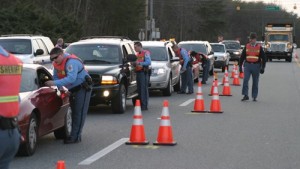
Everyone understands that the wife is the victim; that her freedom and dignity have been violated. It works the same outside the bounds of marriage, as when we are terrorized by the government which treats us as presumptive terrorists and presumptive drunk drivers, etc.
We are also harmed by being constrained.
You aren’t allowed to do X or Y – or forced to do Z, contrary to your own wishes, because someone else believes their judgment ought to override yours and uses threats to extort your obedience.
Some people are quite capable of safely driving much faster than the posted speed limit – because they are naturally better drivers, have more skill and so on – while others are incapable of driving safely at the speed limit. Why should the former be punished while the latter is left in peace?

The answer is, arbitrarily – just because.
There’s no objective standard. Just bureaucratic decrees – and generalized prohibitions (and punishments). It doesn’t matter that what you did – or did not do – didn’t cause harm.
But it ought to matter very much.
In fact, it ought to be the only thing that matters.
Which is better-sounding to you: The possibility that a relative handful of people – none of whom wield legally enforceable power over you – might do something that could result in harm, not to everyone, but to one or maybe a few people? Or the certainty of everyone being harmed or threatened with harm for doing – or not doing – things that haven’t caused harm to anyone?
Risk of harm will always exist. The choice is whether to bureaucratize, codify and enshrine it or accept it as a peripheral vicissitude of life that will probably not visit most of us, most of the time.

How many of you reading this have ever been hit by a drunk driver? How many of you have had to produce “papers” at a checkpoint? Would you rather be free to travel, secure in the knowledge that no armed government goon could molest you without cause – or accept molestation without cause so that the armed goons are better able to catch the occasional drunk?
If you believe seriously in the idea that men aren’t cattle – or rather, that some men aren’t cowboys, entitled to herd cattle – then you must take seriously the idea that a man who hasn’t harmed anyone has a right to not be restricted or controlled or punished until his actions actually have caused harm.
But that’s not an idea that’s even considered much these days – most people having been scared into cringing submission by outlandish, hystericized scenarios about A bombs in the basement and 120 MPH “speeders” running amok in cul-de-sacs.
. . .
Got a question about cars, Libertarian politics – or anything else? Click on the “ask Eric” link and send ’em in!
#1: Vicomte13 To: Deckard (#0)
Vicomte13 posted on 2019-11-21 00:27:29 Reply Private Reply
#2: jeremiad To: Vicomte13 (#1)
jeremiad posted on 2019-11-23 15:24:31 Reply Private Reply
#3: Vicomte13 To: jeremiad (#2)
Vicomte13 posted on 2019-11-23 21:48:23 Reply Private Reply
#4: Vicomte13 To: All (#3)
Vicomte13 posted on 2019-11-24 10:08:29 Reply Private Reply
#5: A K A Stone To: Vicomte13 (#4)
The constitution is based on words. Words have meanings. The meanings should prevail on any an all court cases and legal decisions. If you want more limits then the words in the constitution say. Then you are free to amend the constitution.
You are not free to put limits that the words themselves do not say.
I like truth. You like to pretend words don't mean what they say and your opinion should prevail.
A K A Stone posted on 2019-11-24 10:38:33 Reply Private Reply
#6: Vicomte13 To: A K A Stone (#5)
In our system, the Courts are charged with the final decision as to the meaning of the words of the Constution. They agree we th me on this one.
Vicomte13 posted on 2019-11-24 18:01:16 Reply Private Reply
#7: A K A Stone To: Vicomte13 (#6)
14And this gospel of the kingdom shall be preached in all the world for a witness unto all nations; and then shall the end come.]
Mark 13:10 10And the gospel must first be published among all nations.
A K A Stone posted on 2019-11-24 21:15:59 Reply Private Reply
#8: A K A Stone To: Vicomte13 (#6)
Nope. I don't know everything or even that much.
A K A Stone posted on 2019-11-24 21:17:12 Reply Private Reply
#9: A K A Stone To: Vicomte13 (#6)
Nope. That describes you. Here is reality.
"(According as it is written, God hath given them the spirit of slumber, eyes that they should not see, and ears that they should not hear;) ... "But the natural man receiveth not the things of the Spirit of God: for they are foolishness unto him: neither can he know them, because they are spiritually discerned."
A K A Stone posted on 2019-11-24 21:19:09 Reply Private Reply
#10: A K A Stone To: Vicomte13 (#6)
I don't use the word blasphemy and you quoted that.
I don't waive my arms around or scream.
I do call people traitors or say treason. You would have to give me an example of when I said it incorrectly.
A K A Stone posted on 2019-11-24 21:21:11 Reply Private Reply
#11: A K A Stone To: Vicomte13 (#6)
Usurped powers. There is nothing in the constitution that says such. That is why like the Bible you rarely cite anything. Maybe the courts should have the final say. But it isn't in the constitution.
A K A Stone posted on 2019-11-24 21:22:58 Reply Private Reply