Health dept reports three more cases in people who visited Hawaii Island.
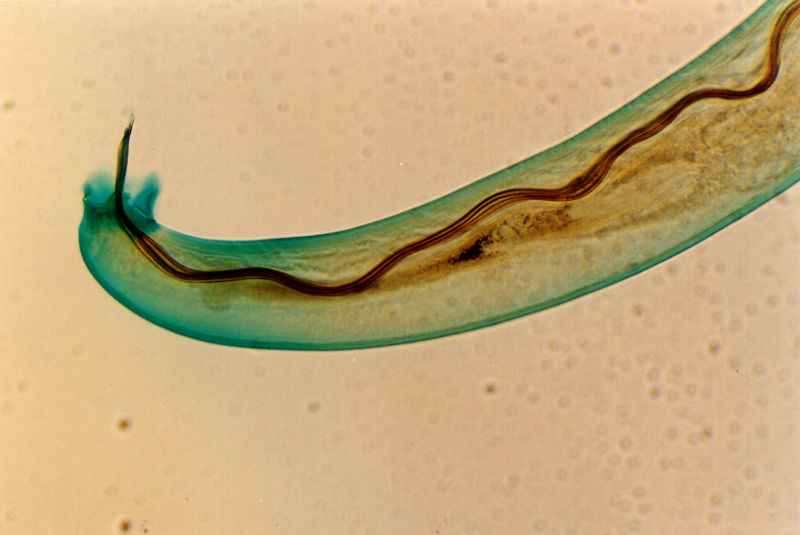
Enlarge / Male Angiostrongylus cantonensis


Hawaii’s health department has released fresh warnings about a parasitic worm that can infest human brains after officials confirmed that three more visitors to the state picked up the infection.
The Centers for Disease Control and Prevention confirmed three new cases in unrelated adults visiting Hawaii Island from the US mainland, the health department announced. The latest known victims—who became infected at different times—bring the state’s 2018 case total to 10 and the 2019 total to five.
While there were 17 confirmed cases in 2017, the state counted only two cases total in the prior decade. The new case counts indicate a sustained boom in the parasite’s population and spread.
The parasitic worm in these cases is the rat lungworm, aka Angiostrongylus cantonensis. As its common name suggests, the wandering worm primarily takes up residence in rats’ lungs, where female worms lay their eggs. Young worms leave the nest early to find their own windy homes, though. Larvae get coughed up into rats’ throats then swallowed. The hosting rat eventually poops out the young parasites, which then get gobbled up by feces-feasting snails and slugs (intermediate hosts). When other rodents come along and eat those infected mollusks, the prepubescent parasites migrate to the rats’ brains to mature before settling into the lungs and reproducing. The cycle then starts again.
Humans are an accidental host, typically infected when they inadvertently eat an infected slug or snail that has slid into their salad fixings or other produce. Officials have blamed the recent boom in human cases, in part, on an explosion of an invasive “semi-slug,” which is particularly good at picking up the parasite.
All in your head
In humans, young worms make their way to the brain as they would in a rat. But the rambling invaders rarely survive long enough to make it to their final destination in the lungs. Instead, they usually die somewhere in the central nervous system. In some cases, the infection is symptomless and resolves on its own. In others, the worm meanders around the brain, and its presence, movement, and death in the central nervous system all contribute to symptoms. Those can vary wildly but sometimes include headaches, neck stiffness, tingling or pain, low-grade fever, nausea, and vomiting. In severe cases, the infection can lead to nerve damage, paralysis, coma, and even death.
Diagnosing the infection can be tricky since there are no specific blood tests that identify the parasite. In Hawaii, officials confirm cases by trying to pick up and amplify fragments of worm DNA from sick patients’ cerebrospinal fluid or other tissue (a polymerase chain reaction test). Still, there are no specific treatments and it’s unclear how helpful anti-parasitic drugs are at clearing the infection. Patients are generally left to manage symptoms and wait for the worms to die on their own. For these reasons, health officials say prevention is paramount.
“It’s important that we ensure our visitors know the precautions to take to prevent rat lungworm disease, which can have severe long-term effects,” Hawaii’s Health Director Bruce Anderson said in a statement. “Getting information to visitors about the disease is just as critical as raising awareness amongst our residents.”
The department recommends that visitors and residents carefully inspect and wash all produce and store it in sealed containers. It also recommends that farmers and gardeners try to control snail and slug populations.
This won’t prevent every case, however. Officials noted that a person in one of the latest confirmed cases became infected in December of 2018 after purposely swallowing a slug on a dare. The other two cases, both from 2019, were suspected to be linked to eating homemade salads and “grazing” fruits and vegetables straight from the land.
Poster Comment:
And now, we have the explanation for BorisY's unique posting style.
#1: Hank Rearden To: Hondo68 (#0)
Hank Rearden posted on 2019-06-01 09:02:03 Reply Private Reply
#2: Liberator To: Hondo68, BorisY (#0)
Possibly. Or maybe Boris is just so relaxed while hanging out on his beach-hammock that he has merely been trolling us?
Speaking of "unique posting style" (OR rather...unhealthy obsession with Trump), this brain-burrowing worm story also made me pause enough to wonder whether you have vacationed in Hawaii after November, 2016 for any prolonged period of time.
Liberator posted on 2019-06-01 15:26:22 Reply Private Reply
#3: buckeroo To: Liberator, Hondo68, BorisY (#2)
Actually borisy is located in a government controlled facility undergoing specious observation.
buckeroo posted on 2019-06-01 16:56:35 Reply Private Reply
#4: Hondo68 To: buckeroo, incoming nuke, duck 'n cover (#3)
Who could forget the FAKE incoming nuclear missile alert in Hawaii. Who knows what else his handlers have up their sleeves?
Hondo68 posted on 2019-06-01 17:33:11 Reply Private Reply
#5: Liberator To: buckeroo, Hondo68, BorisY (#3)
I believe you and others continue to underestimate Boris. He is actually the one conducting observations and monitoring the behavior of LF'ers from his pineapple plantation Hawaiian lair.
Liberator posted on 2019-06-02 12:31:13 Reply Private Reply