Forensic acoustic proof of SECOND shooter in the Las Vegas massacre
| Source: | https://www.youtube.com/watch?v=JxmEFeKy8aI |
| Published: | Oct 11, 2017 |
| Author: | Mike Adams TheHealthRanger |
| Post Date: | 2017-10-11 00:40:47 by A K A Stone |
| Views: | 65960 |
| Source: | https://www.youtube.com/watch?v=JxmEFeKy8aI |
| Published: | Oct 11, 2017 |
| Author: | Mike Adams TheHealthRanger |
| Post Date: | 2017-10-11 00:40:47 by A K A Stone |
| Views: | 65960 |
#89: VxH To: nolu chan (#88)
Where's yours?
{ shrug } Maybe you just don't have what it takes.
VxH posted on 2017-10-24 09:42:51 Reply Private Reply
#90: nolu chan To: VxH (#89)
On your spreadsheet chartoon, notice that you calculate T = Tb - Ts.
You calculate elapsed time as the time it took the bullet to travel, minus the time it took the sound to travel.
As the bullet is supersonic, and sound is a constant, the sound would travel 400 yards in 1.06s and the bullet would travel the 400 yards in less than 1.06s. Subtracting 1.06 from a smaller number will always yield a negative number.
At 1200 feet, you actually calculate Tb as 0.448578s, and Ts as 1.062s and calculate the T as -0.6126, negative 0.6126 seconds. The average donkey could recognize that something is wrong when the result is negative time.
Just what do you think happens in negative 0.6126 seconds?
You could at least recognize that if you get a negative number, you have stated the required formula backwards, and you proceeded to perform the calculation backwards, and present the bass ackwards result of your understanding of the study you looked at.
You've got what it takes to make bullets travel in negative time.
Your brain apparently has zero amplitude.
nolu chan posted on 2017-10-25 02:15:35 Reply Private Reply
#91: VxH To: nolu chan (#90)
>>at 1200 feet, you actually calculate Tb as 0.448578s, and Ts as 1.062s and calculate the T as -0.6126, negative 0.6126 seconds.
0.448578 is the ballistic projectile time. 1.062 is the time to travel the same distance at the speed of sound
The MEASURED, absolute value, of the Ellapsed Time difference, per the audio amplitude graph...
...between the Last Bullet sound event and the Last Report sound event is 0.689655
Now, ask your donkey - what distance does that MEASURED absolute time difference correspond to on the chart?
VxH posted on 2017-10-25 10:14:11 Reply Private Reply
#92: nolu chan To: VxH (#91)
No Absolute value is ever expressed as a negative number. Had your undisclosed formula for the last column of your spreadsheet included code to express an absolute value, your spreadsheet results would not appear as negative numbers. But your spreadsheet displays negative numbers and you did not even question it or fix your spreadsheet.
The results should all be positive, like this:
Bullet Time, Velocity FPS, Tb–Ts
d = distance 400 yards, 1200 feet
Tb = Time of bullet
Ts = Time of sound, 1.062 seconds @ 1,130 feet per second (FPS) (72ºF, 20% Humidity)
Ts – Tb = Time difference between Tb and Ts
Column 1 = d/FPS = time in seconds
Column 2 = Tb stepped in 100 FPS increments, beginning with Ts
Column 3 = Ts – Tb (time in seconds supersonic bullet arrives ahead of sound)
Row 1 = directly inserted data. Data display is set to show 3 decimal places.
Row 2 = spreadsheet formulas
The formulas for Row 2 are dragged down to generate Rows 3-30.
Bullet time (s), Bullet average velocity (FPS), time difference to sound at 1,200 feet (s)
nolu chan posted on 2017-10-25 19:55:59 Reply Private Reply
#93: VxH To: nolu chan (#92)
>>No Absolute value is ever expressed as a negative number.
===========
Since we KNOW from the observed audio Vb is supersonic, we can treat the difference between Tb and Ts as Absolute.
Range corresponds to the ABSOLUTE value of the difference in time.
VxH posted on 2017-10-25 20:06:00 Reply Private Reply
#94: VxH To: nolu chan (#92)
And BTW, You're not even reading from the relevant part of the paper - where the microphone adjacent to the victim scenario is discussed.
http://ww w.btgresearch.org/AcousticReconstruction02042012.pdf
That's the same formula I have in my illustration:
VxH posted on 2017-10-25 20:07:32 Reply Private Reply
#95: nolu chan To: VxH (#93)
I know. They have a spreadsheet function for that. It has been around since Lotus 123 and Quatro. ABS(number).
nolu chan posted on 2017-10-26 02:26:21 Reply Private Reply
#96: VxH To: nolu chan (#95)
Yes, but in this case the ABS is implied in knowledge of what the spreadsheet is actually calculating.
If you applied ABS(Tb-Ts-) the chart would loose the information regarding whether the Vb was super-sonic or not, which the negative numbers conveniently tell us.
The author's formula works just fine without your tweakage.
http://ww w.btgresearch.org/AcousticReconstruction02042012.pdf
And that IS the same formula I have in my illustration:
VxH posted on 2017-10-26 11:08:52 Reply Private Reply
#97: nolu chan To: VxH (#96)
Why do you keep posting this chartoon when all your data is not only wrong, but farcical? The only things you proved is that you do not know how to calculate the average velocity of an imaginary bullet and you are hopeless at spreadsheets. Your entertainment value as a useful idiot is over for now, and you will never figure it out without more help. Help is on the way, grasshopper.
Columns 1, 2, and 3 are direct entry of data generated by entering imaginary data into a generator at http://www.shooterscalculator.com/. I replicated the data taken from the calculator with “My BB's.” If I input initial velocity as 3240 fps, and other data, and call it “My BB's,” I can show a chart for magical bb’s.
http://www.shooterscalculator.com/ballistic-trajectory-chart.php?t=34fa8220
The Shooter’s Calculator only provides a result based on user input. It does not present a spreadsheet with the formulas to generate the data. The data from the Calculator can be cut and pasted into a spreadsheet, or entered by direct entry; this produces data in the cells, but no spreadsheet formulas in the cells. The chart states the speed of sound as 1130 feet per second (fps).
The remaining 4 columns, (4, 5, 6, 7) were generated by VxH.
Column 6 uses 1130.8 fps to calculate the time for sound to travel the distance stated in Column 1.
Column 4 is labeled as (Avg V) Vb. This column purports to present the average velocity of the bullet to cover the distance for the row it is in. All of the data in this column is epically wrong as the methodology of calculation is absurdly wrong.
To calculate the average velocity of the bullet, divide distance by time.
Instead of this, a personal misbegotten formula was used. Probably a pocket calculator for each cell in Column 4 was used to perform the calculations, and the data was directly entered into the cells by hand.
For the first two data rows, sum 3240 and 3163 and divide by 2. 6403/2 yields the 3201 in Column 4.
For the first three data rows, sum 3240+3163+3088 for 9491. 9491 / 3 yields the 3163.6667 in Column 4.
And so on, and so forth. All the calculated Column 4 data (average Vb), is garbage.
The chosen methodology was to sum the velocity given for each distance, and divide by the number of elements summed. This produces nonsensical data.
Example: You drive a car 100 miles at 80 mph. You drive another 100 miles at 20 mph. With this bogus methodology, 80 + 20 = 100, divide by 2, and your average velocity was 50 mph. Not.
In the real world, you drove 100/80 or 1.25 hours at 80 mph. You drove 100/20 or 5 hours at 20 mph. And you drove 200 miles in 6.25 hours. Your average speed was 200/6.25, or 32 mph.
Column 4, in addition to using an absurd methodology for its calculations, also incorporates two summing errors for the velocities taken from Column 3, at 900 feet and 1275 ft. In each case, the actual sum was 1 less than that calculated.
Spreadsheet formulas are not prone to fat finger syndrome, and do not make such errors, but someone with a pocket calculator or pen and paper does. The data was typed in after external calculation.
Where you calculate 2367.5926 average Vb at 1950 feet, 1950/1.211933 (the velocity of the bullet in Column 5), it yields 1608.9998 fps, remarkably close to the 1609 in Column 3. But then, the elapsed time in Column 2 is 0.86, not 1.21933. It is a conundrum how the bullet traveled for 1.21933 seconds in an elapsed time of 0.86 seconds.
Of course, when you use Column 1 1950 ft and Column 3 1609 fps to derive the time of flight, the formula is d/Vb, and Vb is the Average Velocity.
The bullet will travel 1905 feet distance (Col 1) in 0.86 sec time (Col 2) in 1905/0.86 or 2267.4418 average Vb. Stated in your headnote is Tb is d/Vb.
It is noteworthy that you used Column 3 as the "average" velocity of the bullet in order to derive the other average velocity of the bullet in Column 4.
Column 5 (Tb) incorporates the garbage data from Column 4 into its calculations, and all the resulting calculated data is wrong. GIGO.
Column 7 (T = Tb – Ts) incorporates the garbage data from Column 5 and all the calculated data is wrong. GIGO.
The chart is multicolor and pretty, but the data for the imaginary bullet is demonstrably wrong in every column you created, except for column 6 where you succeeded in dividing the distance by 1130.8.
nolu chan posted on 2017-10-28 15:12:09 Reply Private Reply
#98: VxH To: nolu chan (#97)
LOL please tell the class why the bullet accelerates / decelerates / accelerates repeatedly when your "analysis" is applied?
The time in the chart rendered by the ballistic calculator only has 2 decimals of precision.
Calculating the average per the reported velocity is thus more accurate.
VxH posted on 2017-10-28 17:30:33 Reply Private Reply
#99: VxH To: nolu chan (#97)
>> and the data was directly entered into the cells by hand.
Bzzzt. Fail again.
Ballistic Coefficient: 0.300
Bullet Weight: 62 gr
Initial Velocity: 3240 fps
Sight Height : 1.5 in
Shooting Angle: -33°
Wind Angle: 0°
Zero Range: 100 yd
Chart Range: 750 yd
Maximum Range: 50002 yd
Step Size: 25 yd
Adjusted BC: 0.33
Altitude: 2000 ft
Barometric Pressure: 29.92 Hg
Temperature: 72° F
Relative Humidity: 21%
Speed of Sound: 1130 fps
VxH posted on 2017-10-28 17:36:21 Reply Private Reply
#100: nolu chan To: VxH (#98)
d is the target distance.(range)
Vs is the velocity of sound, and
Vb is the average bullet velocity over the distance
Tb is d / Vb (time to cover distance @ Vb)
Ts is d/Vs (time to cover distance @Vs)
More accurate is to divide the distance by the velocity and get the time to more decimal places and eliminate the rounding error. Your bullshit methodology of summing velocities and dividing does not work. It is bullshit.
Your chart in Column 2 from btgresearch indicates Tb for range 1950 is 0.86 seconds. Column 5 for 1950 range indicates Tb is 0.823621. You call that fixing a rounding error???? How did displaying only two decimal places to 0.86 convert to 0.823621.
Of course, the time of 0.02 could represent a figure rounded to two decimal places for presentation, and actually represent anything from 0.0150 to 0.0249.
75 feet divided by Vel[x] 3239 75/3239 feet, taken to six decimal places gives 0.0231552 seconds bullet travel time. Hot damn, it's within the rounding error.
At Vel[x+y] 3240 feet per second, and 75 feet distance, the time to six decimal places would be 0.0231481 seconds bullet travel time and hot damn, that's within the rounding error too.
You have the distance and velocity as a given from btgresearch. Divide the distance by the velocity d/V, and you can calculate the time to however many decimal places you desire.
The stupid... it hurts!
The chart results are based on the data you entered.
As I demonstratred, the same data entered for My BB's produces a chart with the same data for BB's.
If the chart correctly calculated the ballistic data for the parameters you entered,
http://www.shooterscalculator.com/ballistic-trajectory-chart.php?t=34fa8220
Tell everybody how you derived average velocity.
Come on. Question my analysis of how you made a botch of the Average Bullet Velocity. Give us your methodology and formula.
Why were all your calculations wrong except for distance divided by time?
The data which you input did not come from any real life ammunition, you just entered stuff, as I did for My BB's. I just entered the same stuff you did, proving my bb's have an initial Vel[x+y] of 3240 fps. My BB's perform precisely as do your imaginary cartridge. Are you saying the ballistics chart you used produced invalid results?
If the chart results are valid, please tell the class why the chart indicates the bullet traveled 75 ft. in 0.02 seconds and that indicates average velocity d/time of 750/.02 = 3750 fps.
It's your data. If the ballistics chart calculated correctly, you should understand the chart you presented, and be able to explain the results given.
Do you think you are entitled to just use a nonsense formula which produces nosense results because you do not understand the chart data that you selected and presented?
The note at the bottom of the chart indicates:
Thank you, Lord.
nolu chan posted on 2017-10-28 23:52:47 Reply Private Reply
#101: nolu chan To: VxH, A K A Stone (#99)
Nope. You said you created spreadsheet and used their formulas. Had you used their formulas you would not have bullshit results, including arithmetic errors in the columns.
Which formula of theirs did you use to manufacture the wrong bullet velocities?
Cite any source that says to find average velocity with the method you used.
When you introduced this bullshit on the other thread at your #19 to A K A Stone, you said:
https://libertysflame.com/cgi-bin/readart.cgi?ArtNum=53046&Disp=19#C19
Only you did not use their formulas or you would not have gotten all the data you derived bass ackwards wrong, and you did not create formulas and drag them down through the rows, or you would not have the calculation errors the are apparent.
I created a spreadsheet using the same data and created formulas and dragged them down through the rows. They work. That is how I can pinpoint where you made calculating errors in your data entry.
All you did was cut and paste the chart data into a spreadsheet workbook.
Columns 1 thru 3 were cut and paste.
For Column 4, there is no chance that you created a formula and dragged it down through the rows. You go off at range 900 where you summed to 36497 instead of 36496. This error of 1 continues through to range 1275, where you summed to 47,572 instead of 45,570. This put the summing error at 2, which continued through range 1950 where you ended.
This is not a spreadsheet error. I used two different formulas to sum the velocities, with results identical to each other. You used no formula. You sat there with your pocket calculator and added the first two and typed in the result. Then you added the third velocity and typed in the result. And you did this for each data entry in that column. If you have any spreadsheet formula that can replicate your results, produce it.
As Column 4 calculates the sum of the velocities divided by the number of velocities, and the sum of the velocities was not created by a formula on a spreadsheet column, the column was manual data entry.
In Column 5, d/Vb, the distance is correctly divided by the bogus average velocity, yielding a bogus result. When it is as simple as programming one column divided by another, good job. When it is summing a changing number of rows, fuhgetaboutit. That was direct data entry with arithmetic errors.
In Column 6, I stated you were able to divide distance by 1130.8. When it is summing a changing number of rows, fuhgetaboutit. That was direct data entry with arithmetic errors.
In Column 7, you managed to correctly subtract the bogus data in Column 5 from the bogus data in Column 6, yielding all bogus results. When it is as simple as programming one column subtracted from another, good job. It should have included an ABS function to avoid getting negative time results.When it is summing a changing number of rows, fuhgetaboutit. That was direct data entry with arithmetic errors.
As Columns 5 and 7 incorporate the brain dead data in Column 4, with a double whammy of a bogus formula and calculation errors, all data in Columns 5 and 7 is bogus.
Your chart in Column 2 from btgresearch indicates Tb for range 1950 is 0.86 seconds. Column 5 for 1950 range indicates Tb is 0.823621. You call that fixing a rounding error???? How did displaying only two decimal places to 0.86 convert to 0.823621????
nolu chan posted on 2017-10-29 00:02:55 Reply Private Reply
#102: VxH To: nolu chan (#101)
Bzzzt. Another Nolu-FAIL.
=SUM(C9:C10)/L9
=SUM(C$9:C11)/L10
=SUM(C$9:C12)/L11
etc.
Where column L contains 1 @ row 8 and =+L8+1, =+L9+1 etc for rows 9..34
Now please tell us how Nolu-Time works and then explain why the values of Column J are closer to Time (Column B) than Nolu-Time(Column I)?
VxH posted on 2017-10-29 01:06:56 Reply Private Reply
#103: A K A Stone To: VxH (#102)
A K A Stone posted on 2017-10-29 10:19:34 Reply Private Reply
#104: buckeroo To: A K A Stone (#103)
buckeroo posted on 2017-10-29 10:22:48 Reply Private Reply
#105: VxH To: nolu chan (#101)
I correctly illustrate the flaw inherent in taking a momentary point velocity of a continuously decelerating proctile and ASSuming it to be an average.
There's a question regarding whether the value of Vel[x+y] for a given 75ft vector segment is the average Velocity OR whether it's just the momentry V at point d.
Here is the spreadsheet updated with Tcalc where Tcalc is an attempt to reconstruct the elapsed Time for a given Vector:
We're moving in the right direction - but the calculation for Tcalc could be even more accurate by deriving it from the slope of the DIFFERENCE between Vmin and Vmax for a given vector segment, rather than taking momentary V at point d and ASSuming it's a constant velocity over the entire 75ft segment... like you are.
VxH posted on 2017-10-29 10:56:39 Reply Private Reply
#106: VxH To: A K A Stone (#103)
Says the genius who posts videos with scribbling on a whiteboard presented as "PROOF".
Can you solve for T given a 75 foot vector having Vmin and Vmax?
Let's see if Noluchan's donkey can!
VxH posted on 2017-10-29 11:13:23 Reply Private Reply
#107: A K A Stone To: VxH (#106)
A K A Stone posted on 2017-10-29 11:15:10 Reply Private Reply
#108: VxH To: A K A Stone (#107)
How's that workin' for ya?
Meanwhile:
Q: Can you solve for T given a 75 foot vector having Vmin and Vmax?
A: { crickets crickets crickets }
VxH posted on 2017-10-29 11:19:56 Reply Private Reply
#109: A K A Stone To: VxH (#108)
Could you provide me a list of all of your errors that you posted so I can remove them from the site so people don't look at bullshit?
A K A Stone posted on 2017-10-29 11:37:40 Reply Private Reply
#110: A K A Stone To: VxH (#108)
Blue 42 Blue 42 hut hut hike.
Ok I proved you are wrong.
A K A Stone posted on 2017-10-29 11:39:10 Reply Private Reply
#111: A K A Stone To: buckeroo (#104)
My mind it is a beautiful thing.
A K A Stone posted on 2017-10-29 11:41:39 Reply Private Reply
#112: buckeroo To: A K A Stone (#111)
buckeroo posted on 2017-10-29 11:44:01 Reply Private Reply
#113: A K A Stone To: buckeroo (#112)
You agree with his analysis 100 percent correct.
Or is your mind superior like mine and know that his analysis is bullshit. To many errors. To many things not factored in.
I'm not saying that there were multiple shooters. I'm not saying Pollock or Paddock or whatever his name was didn't act alone.
I'm just saying what V dude offers as 100 percent conclusive proof is not conclusive or proof.
A K A Stone posted on 2017-10-29 11:47:17 Reply Private Reply
#114: A K A Stone To: VxH (#106)
Says the genius who made up an image with lots of wrong and made up numbers.
I know the truth know. Spock is controlling your mind.
A K A Stone posted on 2017-10-29 11:51:56 Reply Private Reply
#115: VxH To: A K A Stone (#109)
Does that work in AKA Stoned Land?
There's nothing wrong with refining an analysis in the context of an honest desire to seek the truth.
Time is still not being calculated with 100% accuracy. Why is that?
VxH posted on 2017-10-29 12:01:45 Reply Private Reply
#116: A K A Stone To: VxH (#115)
That is fine.
Truth also works if false things are no longer out there.
If you care about truth why don't you find a list of all the posts yoy made with errors so we can correct them with the latest and the greatest.
A K A Stone posted on 2017-10-29 12:04:55 Reply Private Reply
#117: VxH To: A K A Stone (#116)
In this case, the truth is still a work in process.
For the next step in the process - Maybe "yoy" and Noluchan's donkey can tell us why applying a linear calculation (d/v) to a non-linear velocity produces values for Time which are farther away from the Ballistic chart's value for T than rounding can explain?
VxH posted on 2017-10-29 14:36:25 Reply Private Reply
#118: buckeroo To: VxH, A K A Stone, noluchan (#117)
ROTFL
buckeroo posted on 2017-10-29 14:39:09 Reply Private Reply
#119: VxH To: A K A Stone, noluchan, buckeroo (#117)
So,
Illustration A: Vb calculated from d/Tcalc, where Tcalc= (d=75ft)/Vel
Illustration B: Vb using my original Average of summed Velocity values.
A: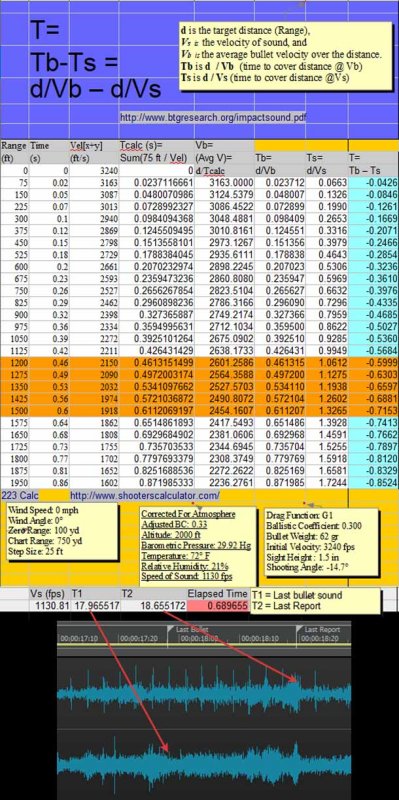 B:
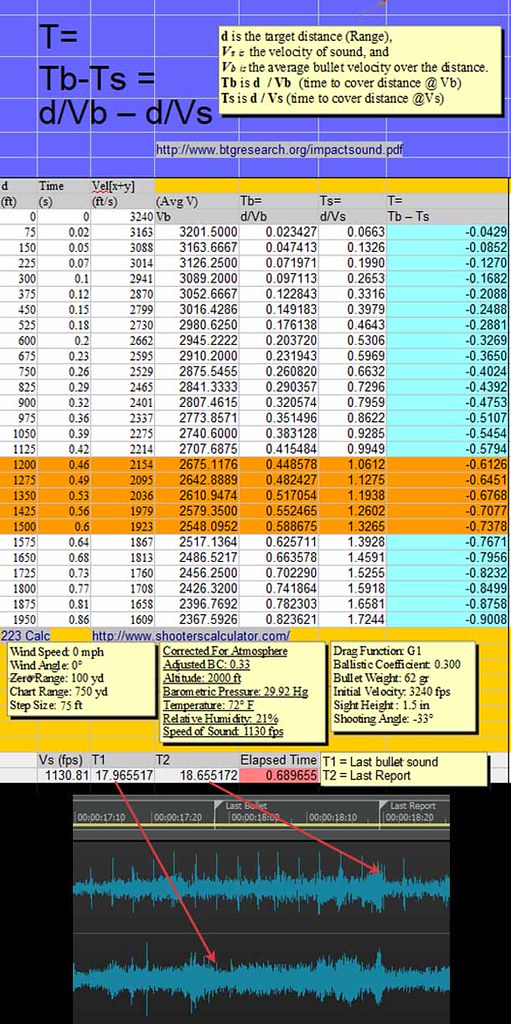
Please explain how, in the context of the highlighted range of interest on the concert field, Noluchan's idea to reconstruct Time by taking (d=75ft)/Vel[x+y]
does not seem to produce results that magically render the values produced by summing and averaging Vel[x+y] into "bullshit"
?
Feel free to consult Noluchan's Donkey, since it probably has better temperament and reading comprehension skills than either of you two have demonstrated.
VxH posted on 2017-10-30 15:29:29 Reply Private Reply
#120: nolu chan To: VxH, A K A Stone (#105)
The problem is that you are clueless and do not know what your are doing and do not know what a vector is.
Here is a correct spreadsheet:
BALLISTICS DATA SPREADSHEET
As a vector is described by a line and not a point, the Column D velocity at 75 feet describes the average bullet velocity for the segment from 0 to 75 feet, and the velocity at 150 feet describes the average bullet velocity from 0 to 150 feet, and so on.
The time for 75 feet indicates the elapsed time for 0 to 75 feet. The time for 150 feet indicates the elapsed time for 0 to 150 feet.
Column C, the time, is derived by dividing Column B (distance) by Column D. In your chart it is was rounded off to two decimal places. I took it to four decimal places.
Your added Rube Goldberg nonsense was not only wrong but unecessary. Average velocity at the stated distances was staring you in the face.
In Columns H thru L, I have provided the data for each 75-foot segment.
At 1575 feet, the bullet opens its largest gap on sound at 0.05502 seconds.
From 1575 to 1650 feet, the bullet travels at an average velocity of 1127.9144 fps, dipping below the speed of sound. After that, sound is traveling faster than the bullet and the gap diminishes.
nolu chan posted on 2017-10-30 19:52:22 Reply Private Reply
#121: VxH To: nolu chan (#120)
>>Here is a correct spreadsheet
Too bad it's not one you created with ballistic data as per the methodology:
http://www.btgr esearch.org/AcousticReconstruction02042012.pdf
Meanwhile,
Please explain how, in the context of the highlighted range of interest on the concert field, Your idea to reconstruct Time by taking (d=75ft)/Vel[x+y] does not seem to produce results that magically render the values produced by summing and averaging Vel[x+y] into " bullshit"
?
Illustration A: Vb calculated from d/Tcalc, where Tcalc= (d=75ft)/Vel
Illustration B: Vb using my original Average of summed Velocity values.
A: B:

Please explain how, in the context of the highlighted range of interest on the concert field, Noluchan's idea to reconstruct Time by taking (d=75ft)/Vel[x+y]
does not seem to produce results that magically render the values produced by summing and averaging Vel[x+y] into " bullshit"
?
VxH posted on 2017-10-30 21:09:34 Reply Private Reply
#122: Tooconservative To: VxH (#121)
There are experts out there. So why aren't we hearing from them? Is it because they find the audio data to be ambiguous? Who knows.
Tooconservative posted on 2017-10-30 21:15:42 Reply Private Reply
#123: VxH To: Tooconservative (#122)
I asked the authors of the study
http://www.btgresearch.org/AcousticReconstruction02042012.pdf
They replied:
"our standard operating procedure is to avoid public comments on shooting events. This better protects our neutrality and value of our analysis in the event that we are retained by an agency or party to subsequent legal proceedings. We also like to restrict our analysis to materials that come into our possession following a proper and documented chain of custody regarding handling of evidence.
When it comes time for depositions or courtroom testimony, most experts who have made prior public comments on a matter find that opposing legal counsel, opposing experts, and the blogosphere find ways to make them regret earlier public comments."
===============
In light of what can be observed here - that makes sense.
VxH posted on 2017-10-30 21:22:28 Reply Private Reply
#124: Tooconservative To: VxH (#123)
Tooconservative posted on 2017-10-30 21:30:24 Reply Private Reply
#125: VxH To: Tooconservative (#124)
Yeah. In the meantime, I've found this exercise to be a worthwhile learning experience.
VxH posted on 2017-10-30 21:38:09 Reply Private Reply
#126: VxH To: nolu chan (#120)
At 1950 ft your "spreadsheet" has an elapsed time of 1.2119 with a corresponding Vel[x+y] of 1609.
Meanwhile observe the corresponding elapsed time and Vel[x+y] generated by:
ShooterCalculator.com
Ballistic Coefficient: 0.300
Bullet Weight: 62 gr
Initial Velocity: 3240 fps
Sight Height : 1.5 in
Shooting Angle: -33°
Wind Angle: 0°
Zero Range: 100 yd
Chart Range: 750 yd
Maximum Range: 50002 yd
Step Size: 25 yd
Adjusted BC: 0.33
Altitude: 2000 ft
Barometric Pressure: 29.92 Hg
Temperature: 72° F
Relative Humidity: 21%
OOPS!
How'd ya manage to do that, Professor DonkyChan?
VxH posted on 2017-10-30 22:13:42 Reply Private Reply
#127: Tooconservative To: VxH (#125)
I'm not telling you to stop or that you're wasting your time. You might stumble over something unnoticed by everyone. Recall how Dan Rather was brought down by a persistent guy that noticed the fonts in the fake documents about Dumbya's military service.
Tooconservative posted on 2017-10-30 22:39:20 Reply Private Reply
#128: nolu chan To: VxH, A K A Stone (#119)
If your Column c, Vel[x+y] (ft/s) represents an instantaneous velocity, it cannot be used in this manner.
Make up your mind, does Column C represent instantaneous velocities, valid only at a single point, and not over any range?
nolu chan posted on 2017-11-01 01:43:34 Reply Private Reply
#129: VxH To: nolu chan (#128)
Says the Donkey who managed to transform 0.86 seconds into 1.2119 seconds.
Meanwhile...
http://www.answers.com/Q /What_is_instantaneous_slope
As per what I said in https://libertysflame.com/cgi-bin/readart.cgi? ArtNum=53046&Disp=105#C105 the next step in the quest is to explore methods of deriving Time relative to the slope of the DIFFERENCE between Vmin and Vmax for a given vector segment.
VxH posted on 2017-11-01 01:50:35 Reply Private Reply
#130: nolu chan To: VxH, A K A Stone (#129)
To find what is at your source, we go to the link, which, like the link to the Khan Academy, only shows that you are bullshitting.
You seem to have a special affinity in providing cut and paste bullshit as as some sort of profound knowledge.
http://www.answers.com/Q/What_is_instantaneous_slope
Of course, the calculus formula P = limh—>0 [f(x+h) - f(x)]÷h = df/dx, where h is the distance between P and Q, f(x) is the position of P, f(x+h) is the position of Q, and df/dx is the derivative of the curve with respect to x was not used anywhere in your spreadsheet, so you are just bullshitting.
Also,
However, the slope of a bullet in flight is constantly changing, the deceleration is not constant, and the slope contains an infinite number of points.
Moreover, you have merely bullshitted and have not described any formula to obtain the average velocity of the bullet over a given range, using instantaneous velocities.
While you claim calculus formulas in your spreadsheet, you have yet to show a formula to sum changing parts of a spreadsheet column, i.e., sum row 1 and 2, sum row 1 thru 3, then row 1 thru 4, and so forth. I used such a formula and it showed that your column contained arithmetical errors not created by a spreadsheet formula. When you can program adding sums, I'll consider you doing calculus. As it is, you have not demostrated the ability to consistently add two numbers together, which is what you did to to sum that column. You added rows 1 and 2 to get the row 2 total; then you added row 3 to get the row 3 total, and so on, making two errors in 26 rows. You are fortunate it was now a thousand rows on a spreadsheet in a finance office.
The formula for calculating average velocity (d/t) is given by the Khan Academy in the video you referenced. In their example, they divide a distance fo 1000m by 200s and get an average velocity of 5 m/s, and then they explicitly state, that siad result "doesn't necessarily equal the instantaneous velocities at particular points."
The Khan Academy does not say that you can sum two instantaneous velocities and divide by two, and get an average velocity between the two points. See what you referenced. The first sentence is important — pretend you are a physics student.
https://www.khanacademy.org/science/physics/one-dimensional-motion/displacement-velocity-time/v/instantaneous-speed-and-velocity
Just as your instantaneous velocity at two discrete and infinitesimal points can not be summed and divided by two to obtain average velocity, the instantaneous slope at two discrete and infinitesimal points will be different and cannot be used to calculate the slope of a traveling bullet whose velocity is contantly changing.
While this bullshit about instantaneous slopes has diverted from your other bullshit about instantaneous velocities, you are still left searching to explain
(1) your calculation used to derive average velocity over the specified distances,
(2) your calculation used to change the formula for calculating average velocity over distance.
Your chart stipulated distance and time.
For 75 feet, you stipulated 0.02 seconds. This is your data, not mine.
Using the formula, d/t=V(avg), that is 3,750 feet per second average velocity.
If we assume that you meant the time to be anything between 0.015 and 0.025 seconds, that is 3000 - 5000 feet per second average velocity.
For 1950 feet, you stipulated 0.86 seconds, and an average velocity of 2367.5926 feet per second, obtained by a formula you can neither present nor explain, nor can you provide any citation to any authority for your bullshit calculation.
V(avg) = d/t = 1950/0.86 = 2267.4418 feet per second average velocity.
If we assume that you meant the time to be anything between 0.855 and 0.865, then,
V(avg) may equal 1950/0.0855 = 2280.7017
V(avg) may equal 1950/0.0865 = 2254.3353
Meanwhile, your bullshit 2367.5926 average velocity allows one to derive the time required to travel 1950 feet. 1950/2367.5926 = 0.823621429 seconds.
Indeed, your second time for Tb, the time of the bullet, in your column E, reflects a bullet flight time of 0.823621 seconds, giving three less decimal points than I did, but rounding the the same precise thing at your chosen four decimal places, indicating how you derived that bullshit Tb from the bullshit average velocity.
To check whether this bullshit time is not impossible with the stipulated data, one need only check if it is within the rounding possibilities of the stipulated data, i.e., from 0.855 to 0.865 seconds. Oh noes, your bullshit average velocity (0.823621) is not possible to reconcile with the stiplulated time, even allowing for the maximum rounding error. Your misbegotten time would round to 0.82 instead of 0.86.
You have yet to explain how you can stipulate a bullet time of 0.86 seconds, and through the magic of VxH formulas, transform that time into 0.823621 seconds, and then use that visibly bullshit time to perform further bullshit calculations.
If the bullet flew 1950 feet in 0.823621, why sure enough it went at an average velocity of 2367.5938 and covered 1950 feet.
However, at the stipulated time of 0.86 seconds, at the bullshit average velocity of 2367.5938 feet per second, the bullet would have flown 2036.1307 feet. The stipulated distance is 1950 feet.
At the maximum rounding down error to 0.855 seconds, at your bullshit average velocity of 2367.5926, the bullet would have flown 2024.292699 feet (0.855 x 2367.5926). The stipulated distance is 1950 feet.
With your stipulated data, you may not have more or less than 1950 feet. You may not have less than 0.855 seconds flight time, nor more than 0.865 seconds flight time. You cannot change the distance the bullet flew, nor do more than consider a rounding error on the time. Your calculated numbers fail miserably.
Your bullshit calculated numbers fall outside the maximum possible error attributable to a rounding error.
Your bullshit calculations result in a new time, not within any rounding error, replacing 0.86 with 0.823621.
Your bullshit average velocity over 1950 feet (2367.5926), at the maximum rounding error for stipulated time (0.86 rounded down to 0.855), requires the bullet to fly a minimum of 2024.292699 feet.
WHY IS YOUR CALCULATED DATA OUTSIDE THE POSSIBLE LIMITS OF A TIME ROUNDING ERROR???
nolu chan posted on 2017-11-02 20:08:24 Reply Private Reply
#131: VxH To: nolu chan (#130)
LOL. Idiot.
ShooterCalculator.com Says:
Ballistic Coefficient: 0.300
Bullet Weight: 62 gr
Initial Velocity: 3240 fps
Sight Height : 1.5 in
Shooting Angle: -33°
Wind Angle: 0°
Zero Range: 100 yd
Chart Range: 750 yd
Maximum Range: 50002 yd
Step Size: 25 yd
Adjusted BC: 0.33
Altitude: 2000 ft
Barometric Pressure: 29.92 Hg
Temperature: 72° F
Relative Humidity: 21%
========================
Professor DonkeyChan says:
1.2119 seconds
VxH posted on 2017-11-03 13:47:13 Reply Private Reply
#132: nolu chan To: VxH, A K A Stone (#131)
WHY IS YOUR CALCULATED DATA OUTSIDE THE POSSIBLE LIMITS OF A TIME ROUNDING ERROR???
Column B of above spreadsheet shows the specified distance and the specified time for that distance.
Column C shows the specified time for the distance traveled.
Column D shows the time rounded down to the minimum time possibly explained by rounding.
Column E shows the time rounded up to the maximum time possibly explained by rounding.
Column F shows the Average Velocity (d/t) calculated with the unadjusted time from Column C.
Column G shows the Average Velocity (d/t) calculated with the minimum time possible from Column D. This minimum time of flight shows the maximum possible average velocity of the bullet.
Column H shows the Average Velocity (d/t) calculsted with the maximum time possible from Column E. This maximum time of flight show the minimum average velocity of the bullet.
Column I shows the time for sound to travel the distance at 1130 fps.
Column J shows the time difference between the bullet and the sound using unadjusted time from Column C.
Column K shows the maximum possible time difference between the bullet and the sound using the time rounded down in Column D.
Column L shows the minimum possible time difference between the bullet and the sound using the time rounded up in Column E.
Column N states VXH Average Velocity using undisclosed math, presumably of Klingon origin.
Column O states the instantaneous velocities at the distances specified in Column B. These velocities reflect a specific and infinitesimal point it time only, and do not describe velocity at any other point in time.
Comparing Columns H and N, Column H calculates the maximum possible average velocity with the time round down as far is is possible. Column N is the average velocity claimed by VxH, using his secret Klingon mathematics.
Notice his secret method obtain an average velocity well below the maximum possible for 75 feet, but comes nearer to the maximum possible with every calculation, and at 1200 feet his calculations leave the realm of the possible.
At 1200 feet, at the specified time of 0.46 seconds, the average velocity would be 2608.70 feet per second (1200/0.46). Anyone can do the arithmetic. At 1200 feet, at 0.46 seconds rounded down as far as possible to 0.455 seconds (Column D), the maximum average veocity of 2637.36 feet per second (Column G) is achieved (2637.36/0.455). Anyone can still do the arithmetic. At this point, the VxH calculations exceed the possibilities of reality and achieve 2675.1176 feet per second.
After this point, every VxH calculation widens the error.
At 1950 feet, the Column G max average velocity is 2280.70 (1950/0.0855). After more calculations, the VxH error expands the difference to 2367.5926 feet per second.
If carried on to further distances, the error will simply keep increasing. He started with 64% of the maximum possible average velocity, and surpassed 100% of the maximum on his 16th calculation, and continued to surpass the maximum possible average velocity by a greater and greater amount.
Moreover, the distance and the time were a given.
Notice how VxH, in his calculations, at and after 1200 feet, reduces the time of flight of the bullet by more than any possible amount of rounding from two decimal places.
By 1950 feet, VxH has "rounded off" 0.86 and amazingly reduced the stated flight time to his own preferred 0.82621.
nolu chan posted on 2017-11-05 01:41:06 Reply Private Reply
#133: VxH To: nolu chan (#132)
>>By 1950 feet, VxH has "rounded off" 0.86
Nope. Not a rounding error Super Genius. It's an artifact manufacted from the AVERAGING curve.
>>preferred 0.82621.
Nope. Try to keep up - - I've moved on with a revised curve that reconstructs time from Velocity and Distance,
As per what I said in https://libertysflame.com/cgi-bin/readart.cgi? ArtNum=53046&Disp=105#C105 the next step in the quest is to explore methods of deriving Time relative to the slope of the DIFFERENCE between Vmin and Vmax for a given vector segment.
So, Professor DonkeyChan -- Here is the ballistic data table generated for 1 yard intervals from 1875 to 1950 ft.
http://www.shooterscalculator.com/ballistic- trajectory-chart.php? pl=223+RemingtonLVA&presets=223+RemingtonLVA~%5BChart+Label%5D~G1~0.300~62~3240~ 100~1.5~-33~0~0~true~2000~72~29.92~21~true~1000~25&df=G1&bc=0.300&bw=62& amp; amp; amp; amp;vi=3240&zr=100&sh=1.5&sa=-33&ws=0&wa=0&cfa=on&alt=0& amp; amp; amp; amp;tmp=72&bar=29.92&hum=21&ssb=on&cr=1000&ss=1&chartColumns =Range~ft%3BTime~s%3BVel%5Bx%2By%5D~ft%2Fs&lbl=Test&submitst=+Create+Chart+
Now tell us, Professor DonkeyChan - from the data provided, what is the average Velocity for the 75 ft segment ending at 1950 ft (1950ft, being the point at which, BTW, the instantaneous velocity is 1609fps)?
VxH posted on 2017-11-05 06:36:35 Reply Private Reply
#134: A K A Stone To: VxH (#133)
A K A Stone posted on 2017-11-05 07:36:31 Reply Private Reply
#135: VxH To: A K A Stone, NoluChan (#134)
Nah, foolish is not knowing that in order to recreate the ballistic data curve (and thus the average Velocity over a given distance) with complete accuracy would require duplicating the function used in the Ballistic chart generator.
Meanwhile, averaging via various methods to get an approximation is completely acceptable - and USEFUL for gaining an understanding into what the audio is telling us.
VxH posted on 2017-11-05 15:04:13 Reply Private Reply
#136: buckeroo To: VxH, A K A Stone, NoluChan (#135)
buckeroo posted on 2017-11-05 15:36:00 Reply Private Reply
#137: nolu chan To: VxH (#133)
You have explored methods which require require rewriting the bullet flight times far beyond any possible rounding error. Reconstructing the given travel time is VxH BULLSHIT.
YOUR CALCULATED DATA IS ALL BULLSHIT, AS ARE YOU
Time and distance are given. Rounding the given time up or down does not help your bullshit work. Your bullshit methodology changes the given 0.86 seconds elapsed time to 0.82 seconds.
There is no valid formula in the world for that.
Time and distance are given data. Average velocity equals distance divided by time. Distance in feet, divideded by time in seconds, yields velocity in feet per second.
WHY IS YOUR CALCULATED DATA OUTSIDE THE POSSIBLE LIMITS OF A TIME ROUNDING ERROR???
Column B of above spreadsheet shows the specified distance and the specified time for that distance.
Column C shows the specified time for the distance traveled.
Column D shows the time rounded down to the minimum time possibly explained by rounding.
Column E shows the time rounded up to the maximum time possibly explained by rounding.
Column F shows the Average Velocity (d/t) calculated with the unadjusted time from Column C.
Column G shows the Average Velocity (d/t) calculated with the minimum time possible from Column D. This minimum time of flight shows the maximum possible average velocity of the bullet.
Column H shows the Average Velocity (d/t) calculsted with the maximum time possible from Column E. This maximum time of flight show the minimum average velocity of the bullet.
Column I shows the time for sound to travel the distance at 1130 fps.
Column J shows the time difference between the bullet and the sound using unadjusted time from Column C.
Column K shows the maximum possible time difference between the bullet and the sound using the time rounded down in Column D.
Column L shows the minimum possible time difference between the bullet and the sound using the time rounded up in Column E.
Column N states VXH Average Velocity using undisclosed math, presumably of Klingon origin.
Column O states the instantaneous velocities at the distances specified in Column B. There velocities reflect a specific and infinitesimal point it time only, and do not describe velocity at any other point in time.
Comparing Columns H and N, Column H calculates the maximum possible average velocity with the time round down as far is is possible. Column N is the average velocity claimed by VxH, using his secret Klingon mathematics.
Notice his secret method obtain an average velocity well below the maximum possible for 75 feet, but comes nearer to the maximum possible with every calculation, and at 1200 feet his calculations leave the realm of the possible.
At 1200 feet, at the specified time of 0.46 seconds, the average velocity would be 2608.70 feet per second (1200/0.46). Anyone can do the arithmetic. At 1200 feet, at 0.46 seconds rounded down as far as possible to 0.455 seconds (Column D), the maximum average veocity of 2637.36 feet per second (Column G) is achieved (2637.36/0.455). Anyone can still do the arithmetic. At this point, the VxH calculations exceed the possibilities of reality and achieve 2675.1176 feet per second.
After this point, every VxH calculation widens the error.
At 1950 feet, the Column G max average velocity is 2280.70 (1950/0.0855). After more calculations, the VxH error expands the difference to 2367.5926 feet per second.
If carried on to further distances, the error will simply keep increasing. He started with 64% of the maximum possible average velocity, and surpassed 100% of the maximum on his 16th calculation, and continued to surpass the maximum possible average velocity by a greater and greater amount.
Moreover, the distance and the time were a given.
Notice how VxH, in his calculations, at and after 1200 feet, reduces the time of flight of the bullet by more than any possible amount of rounding from two decimal places.
By 1950 feet, VxH has "rounded off" 0.86 and amazingly calculated, by secret methodology, the stated flight time to his own preferred 0.82621.
That is VxH bullshit. Not only wrong but impossible on its face.
The average velocity of any object covering 1950 feet in 0.86 seconds is 1950/0.86 = 2267.4419 feet per second. It could be a flying refrigerator. If it goes 1950 feet in 0.86 seconds, the average velocity is 2267.4419 seconds.
The object could have sped up and slowed down between 0 and 1950 feet in any manner and it makes no difference. If the object covers the 1950 feet in 0.86 seconds, the average velocity for the 1950 foot distance is 2267.4419 seconds.
Recall the Khan Academy video you previously referenced:
https://www.khanacademy.org/science/physics/one-dimensional-motion/displacement-velocity-time/v/instantaneous-speed-and-velocity
The instantaneous velocity at 1950 feet is irrelevant to the calculation of the average velocity over the range 0 to 1950 feet.
nolu chan posted on 2017-11-06 16:34:40 Reply Private Reply
#138: VxH To: nolu chan (#137)
LOL. It's not a rounding error Professor DonkeyChan.
How you coming along with that Average Velocity for the 75 foot segment ending at 1950 ft?
VxH posted on 2017-11-06 17:39:47 Reply Private Reply