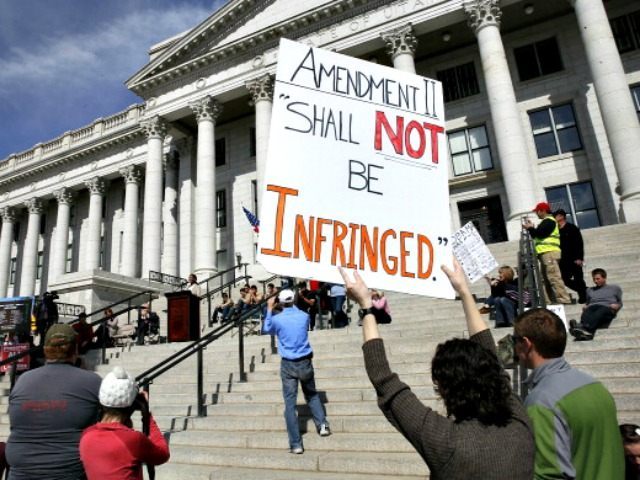
The U.S. Court of Appeals for the Ninth Circuit ruled Monday that the right to bear arms has historically included the right to acquire them, and remanded the case of Teixeira v. County of Alameda to the lower court.
Teixeira revolves around Alameda County zoning rules for incorporated areas that not only require a gun store owner to obtain requisite local, state, and federal permits for the business, but also make sure “the proposed location of the business is not within five hundred feet of a ‘[r]esidentially zoned district; elementary, middle or high school; pre-school or day care center; other firearms sales business; or liquor stores or establishments in which liquor is served.'”
Teixeira revolves around Alameda County zoning rules for incorporated areas that not only require a gun store owner to obtain requisite local, state, and federal permits for the business, but also make sure “the proposed location of the business is not within five hundred feet of a ‘[r]esidentially zoned district; elementary, middle or high school; pre-school or day care center; other firearms sales business; or liquor stores or establishments in which liquor is served.'”
After being denied the requisite county permits to open “Valley Guns and Ammo” — due to complaints of persons within 500 feet of the proposed business — Plaintiff John Teixeira contended that the “500-foot rule” was tantamount to a backdoor ban on gun stores. And while there was some question over the exact distance between the proposed store and some of those who complained, the issue for Teixeira turned on the right of due process and other rights protected by the Second Amendment.
Teixeira challenged Alameda County’s decision in the United States District Court for the Northern District of California and lost. He then appealed the case to the 9th Circuit Court, where the ruling has remanded the case to the lower court.
In summarizing the latest ruling, the court pointed to the Ninth Circuit’s position that Alameda County “had offered nothing to undermine the panel’s conclusion that the right to purchase and to sell firearms is part and parcel of the historically recognized right to keep and to bear arms.”
Writing in the Majority Opinion, 9th Circuit Judge Diarmuid O’Scannlain emphasized, “Our forefathers recognized that the prohibition of commerce in firearms worked to undermine the right to keep and to bear arms.”
O’Scannlain also pointed to the recognition of the importance of buying and selling firearms from the time of the English Bill of Rights (1689) to founding of the United States.
Regarding the era in which the United States was founded, O’Scannlain explained that the states which ratified that Second Amendment did so believing they were not simply protecting a right to keep and bear arms but to buy and sell them as well. He wrote:
The historical record indicates that Americans continued to believe that such right included the freedom to purchase and to sell weapons. In 1793, Thomas Jefferson noted that “[o]ur citizens have always been free to make, vend, and export arms. It is the constant occupation and livelihood of some of them.”
#72: tpaine To: GrandIsland (#71)
Just yesterday, our leader asked for a bit more civility.
This was nolu Chan's line.
tpaine posted on 2016-06-02 20:13:28 Reply Private Reply
#73: nolu chan To: tpaine, GrandIsland (#70)
I'm beating on your sorry ass so bad, could you please affirm that you are over 12 years old. I don't want anyone to accuse me of child abuse.
No, you stupid fuck.
Madison, the Father of the Constitution, and co-author of the Federalist Papers, told them the truth that the Bill of Rights did not apply to the States.
The Supreme Court contained one (1) nominee of Adams, one (1) of Jefferson, two (2) of Madison, two (2) of Monroe, and one (1) of Jackson, when it decided the case of Barron v. Baltimore in 1833.
The opinion of the Court was UNANIMOUS. Every Justice in 1833, including those appointed by Madison, agreed with Madison and found that the Bill of Rights did not apply to the States.
Do tell, dishonorable asshole, were all the Supreme Court Justices still carrying on with your fairy tale of an alleged Madison white lie, or plain outrageous lie to deceive the people into ratifying eight constitutional amendments?
Why, 1833, were all the Supreme Court justices perpetuating what you call a white lie by Madison as a Framer of the Bill of Rights? Why did the seven justices unanimously lie in 1833?
Chief Justice John Marshall -- Federalist [Adams]
Justice William Johnson -- Democratic-Republican Party [Jefferson]
Justice Gabriel Duvall -- Democratic-Republican Party [Madison]
Justice Joseph Story -- Democratic-Republican Party [Madison]
Justice Smith Thompson -- National Republican Party [Monroe]
Justice McLean -- Democraatic-Republican Party [Monroe]
Justice Baldwin -- Democratic Republican Party [Jackson]
https://www.oyez.org/cases/1789-1850/32us243
No. I have always provided, and wish to assure you, that I will always provide you with the all civility and courtesy you deserve.
nolu chan posted on 2016-06-02 21:19:01 Reply Private Reply
#74: GrandIsland To: nolu chan (#73)
But don't lie. If tpaine is an asshole... well then it is what it is.
lol
GrandIsland posted on 2016-06-02 21:46:45 Reply Private Reply
#75: tpaine To: nolu chan (#73)
To Madison, ratification was more important than a white 'lie'.
Because they were attempting to save the Union by telling the slave States what they insisted hearing. -- It worked, --- for a while.
tpaine posted on 2016-06-03 10:36:54 Reply Private Reply
#76: tpaine To: nolu chan (#73)
Belied by your foul mouth just above.
tpaine posted on 2016-06-03 10:44:37 Reply Private Reply
#77: nolu chan To: tpaine (#75)
In 1833? You are a fucking idiot. (Actually you just post make believe fiction to be a pain in the ass, but I like to call you a fucking idiot for doing it.)
I suppose that the States, today, are allowed to ignore the 5th Amendment requirement to obtain a presentment or indictment of a Grand Jury in order to save the union too. Whatever are they trying to tell the slave states today? You are so full of shit.
Amazingly, after the Civil War, the authors of the Fourteenth Amendment stated that the 14th was needed precisely because the Bill of Rights did not apply to the States.
Indeed, was John Bingham "attempting to save the Union by telling the slave States what they insisted hearing?" In 1871. And why was he so down on the racist assholes on Illinois? Had he read the Collected Works of Abraham Lincoln and discovered what old Abe had actually said?
Bingham sure was clear and specific about the Illinois assholes. But at least he didn't delve into Illinois' 99-year indentured servitude.
But why was Bingham saying these things in 1871? To perpetuate your myth that Madison lied when he said the BoR did not aply to the States, and the unanimous Supreme Court lied when they said the same thing, as you say, "attempting to save the Union by telling the slave States what they insisted hearing"? Representative John Bingham
Representative John Bingham and Senator Jacob Howard were co-authors of the Fourteenth Amendment.
Cong. Globe, 42nd Cong., 1st Sess. app. 84 (1871)
nolu chan posted on 2016-06-03 19:47:11 Reply Private Reply
#78: nolu chan To: tpaine (#76)
Belied by your foul mouth just above.
Not at all. You were surely provided all the civility and courtesy you deserve.
You are just one of those loons who feels entitled.
nolu chan posted on 2016-06-03 19:48:36 Reply Private Reply
#79: tpaine To: nolu chan (#77)
You bet, as the question of slavery was a main issue long before the war started. You are a fucking idiot. (Actually you just post make believe fiction to be a pain in the ass, but I like to call you a fucking idiot for doing it.)
You suppose erroneously. It's just not an issue, despite your obsession about it.
Yep, that was the common misconception. -- So the 14th was passed, but still weirdos like you kept insisting that States could ignore gun rights, etc. -- We're still trying to educate you socialistic statists, with little success.
No, he was trying to make sure our individual freedoms were not infringed. -- Clowns like you are still working against that principle.
tpaine posted on 2016-06-03 20:14:53 Reply Private Reply
#80: BorisY To: Roscoe (#17)
per
usual
a
one
bat
chirp
like
the
rest
of
the
bat
clan
crazies
one
good
zitka
virus
will
clean
the
cave
keep
America
skies
clear
great
again
love
boris
BorisY posted on 2016-06-03 20:39:02 Reply Private Reply
#81: nolu chan To: tpaine (#79)
I'm beating on your sorry ass so bad, could you please affirm that you are over 12 years old. I don't want anyone to accuse me of child abuse.
Here, tpaine got caught bullshitting that States used a presentment rather than a Grand Jury, per the 5th amendment. As I documented at #40, to which tpain has never responded, he only documented that he was too ignorant to know that a presentment is made by a grand jury, and he was too lazy to look up a word he did not know. In fact, States typically use an information which is filed without reference to any grand jury or an indictment. It is filed by a competent public officer on his oath rather than by a grand jury on their oath.
Now, the stupid shithead chooses to make believe States are not bound by the Fifth Amendment "presentment or indictment of a Grand Jury" requirement because "[i]t's just not an issue." That's one way to say he had his ass handed to him. Again. Originally, NONE of the Bill of Rights applied to the States. After the Fourteenth Amendment, the Court has selectively incorporated parts of the Bill of Rights into the Fourteenth Amendment and made them applicable to the States.
The Fifth Amendment "presentment or indictment of a Grand Jury" requirement has never been so incorporated and has never applied to the States.
FIFTH AMENDMENT for tpaine and other Idiots
Prior to the Fourteenth Amendment and the subsequent selective incorporation of portions of the Bill of Rights.
Barron v. Baltimore, 32 U.S. 243, 247-48 (1833)
Opinion of the Court, Chief Justice Marshall (7-0)
tpaine hilariously argues that amendments to the Constitution can be unconstitutional, and the the entire Bill of Rights has always applied to the States since it was ratified in 1791.
Of course, only a fucking idiot could look at it and make such an imbecilic argument.
FIRST AMENDMENT for tpaine and other Idiots
Congress shall make no law.
The New Oxford American Dictionary, Second Edition.
Law Dictionary, Second Edition, Barron's Educational Series, Inc., Steven F. Gifis
Black's Law Dictionary, 6th Edition
Congress refers specifically to the two Federal legislative bodies, the Senate and the House of Representatives.
The First Amendment specifically and explicitly states that the United States or Federal Congress may pass no law such as those specified.
It has no applicability whatsoever to any State government. It now has indirect applicability via the 14th Amendment.
Only a fucking idiot, such as tpaine, could make believe that "Congress shall make no law," in the words of the First Amendment, was speaking to State governments.
As John Bingham stated in congressional debate on the floor of the House, in justification of the need for the 14th Amendment, "These eight articles I have shown never 'were limitations upon the power of the States, until made so by the Fourteenth Amendment.' . . . Sir, before ratification of the fourteenth amendment . . . the State could abridge the freedom of the press, and it was so done in half the States of the Union."
Of course, it does not end at the First Amendment. The Seventh Amendment has never been incorporated into the Fourteenth Amendment, and the States are free to ignore it as it has never applied to them. Let me review it and let tpaine look at it for the first time in his life.
SEVENTH AMENDMENT FOR tpaine and other IDIOTS
Every time tpaine has a pissing contest, and the value in controversy exceeds 20 dollars, tpaine hallucinates he is entitled to a jury trial.
Heard of Small Claims Court, you fucking idiot? The Seventh Amendment does not apply and control State court procedures, and has never applied to or controled State court procedures. It is part of the Bill of Rights but it does not apply to the States. Your bullshit is just bullshit. When faced with reality, it falls apart.
Law Dictionary, Second Edition, Barron's Educational Series, Inc., Steven F. Gifis
Black's Law Dictionary, Sixth Edition
http://law.justia.com/codes/us/2013/title-28/part-v/chapter-111/section-1652/
Edwards v Elliott, 88 US 532 (1874)
Walker v. Sauvinet, 92 U.S. 90 (1875)
Gasperini v. Center for Humanities, Inc., 518 U.S. 415 (1996)
http://libertysflame.com/cgi-bin/readart.cgi?ArtNum=40620
http://libertysflame.com/cgi-bin/readart.cgi?ArtNum=40732
Of course, for the best hilarity, tpaine previously argued that an amendment to the Constitution which did not meet with his approval would be unconstitutional.
He attempted to buttress his idiotic argument by citing the losing argument of Elihu Root against the 18th Amendment on prohibition. But Root had not only lost, but he had argued that it was an ordinary piece of legislation and not an amendment at all.
Of course, the Congress is only empowered to legislate pursuant to the Constitution, and any amendment is part of the Constitution.
And the judiciary is no help.
https://supreme.justia.com/cases/federal/us/258/126/case.html
As for the Natural Law bullshit that tpaine likes to make believe is in the Constitution, Justice Oliver Wendell Holmes spoke to that. While the Declaration of Independence, which was never law, spoke loftily about inalienable rights, the Constitution, which is law, dealt with reality.
nolu chan posted on 2016-06-04 19:28:11 Reply Private Reply
#82: BorisY To: nolu chan (#81)
you
still
believe
obomba
is
a
natural
born
citizen
Make
America
constitutional
great
again
love
boris
BorisY posted on 2016-06-04 19:40:53 Reply Private Reply
#83: nolu chan To: tpaine (#79)
CIRCA 1791:
[tpaine #75] Of course Madison knew what they were about, -- but even he, (a slave owner) said that in order to 'sell' the BOR'S to the slave States. Madison shaded/compromised the truth (that the BOR'S applied to States) in order to get the slave States to ratify.
Sometimes you just wonder why did did all that lying but Washington, Jefferson, and Madison didn't just set their slaves free. Maybe we wouldn't have a Declaration of Independence if Jupiter had not kept tom supplied with mint juleps or sweet tea.
CIRCA 1833
[tpaine at #79]
TODAY
[tpaine at #79]
Because, at this point, what difference does it make! The states can try, convict and sentence to death without a grand jury. Hurtado v California, 110 US 516 (1884)
Of course, the States also ignore the 7th Amendment wholesale, disregarding the Federal requirement for a jury trial in suits at common law (civil suits) where the amount in controversy is more than $20. They have been ignoring that non-requirement for more than two centuries.
THE POST CIVIL WAR ERA
I have quoted John Bingham extensively stating that the original Bill of Rights did not apply to the States, and this was what necessitated the Fourteenth Amendment of which Bingham was a co-author. tpaine seems at a loss to explain whether Bingham was just lying in 1866 and 1872, or it just was not an issue. It seems unlikely he ws lying in 1872 in order to get slave states to ratify anything.
And a fine thing it was, all that worrying about slavery. None of that for Illinois. No, sir. They were civilized. They had ninety-nine year indentured servitude.
http://www.eiu.edu/past_tracker/1818_Indenture_Transcription.pdf
nolu chan posted on 2016-06-04 20:31:14 Reply Private Reply
#84: tpaine To: nolu chan (#83)
Please keep wasting your time posting OPINIONS that buttress your opinion above..
You cannot refute that the Constitution itself clearly says otherwise: ---
"This Constitution, and the Laws of the United States which shall be made in Pursuance thereof; and all Treaties made, or which shall be made, under the Authority of the United States, shall be the supreme Law of the Land; and the Judges in every State shall be bound thereby, any Thing in the Constitution or Laws of any State to the Contrary notwithstanding."
tpaine posted on 2016-06-04 22:14:25 Reply Private Reply
#85: nolu chan To: tpaine (#84)
As you wish. And you keep avoiding posting anything that buttresses your bullshit.
Senator Jacob Howard
Representative John Bingham and Senator Jacob Howard were co-authors of the Fourteenth Amendment.
Cong. Globe, 39th Cong., 1st Sess. 2765-66 (1866)
nolu chan posted on 2016-06-05 18:50:16 Reply Private Reply
#86: tpaine To: nolu chan (#85)
Please, keep wasting your time posting OPINIONS that buttress your opinion above..
I'll repeat my last post, which buttresses my position, which you cannot refute, and is part of our Constitution, NOT bullshit: ---
"This Constitution, and the Laws of the United States which shall be made in Pursuance thereof; and all Treaties made, or which shall be made, under the Authority of the United States, shall be the supreme Law of the Land; and the Judges in every State shall be bound thereby, any Thing in the Constitution or Laws of any State to the Contrary notwithstanding."
tpaine posted on 2016-06-06 14:09:30 Reply Private Reply
#87: nolu chan To: tpaine (#86)
As you wish. And you keep avoiding posting anything that buttresses your bullshit.
Thaddeus Stevens, Congressional Globe, 39th Cong., 1st Sess., Vol. 3, pg. 2459, (May 8, 1866)
nolu chan posted on 2016-06-06 21:00:02 Reply Private Reply
#88: tpaine To: nolu chan (#87)
I'll repeat my last post, which buttresses my position, which you cannot refute, and is part of our Constitution, NOT bullshit: ---
"This Constitution, and the Laws of the United States which shall be made in Pursuance thereof; and all Treaties made, or which shall be made, under the Authority of the United States, shall be the supreme Law of the Land; and the Judges in every State shall be bound thereby, any Thing in the Constitution or Laws of any State to the Contrary notwithstanding."
Your reply, quoting the OPINION of Thaddeus Stevens:
--- "But the Constitution limits only the action of Congress, and is not a limitation on the States." ----
Is somehow supposed to refute the constitutional quote I posted?
You reAlly do need rest, as your posting is increasingly bizarro. GET HELP.
tpaine posted on 2016-06-06 21:55:15 Reply Private Reply
#89: nolu chan To: tpaine (#88)
As Supremacy Clause pertains to a conflict of laws. As the Bill of Rights originally did not apply to the States, there was no conflict between the inapplicable Bill of Rights and any State laws.
The members of the union are the States (Art. 8). The States ratified the amendments called the Bill of Rights to place clear restraints on the powers of the Federal government. Amendments to the Federal charter, limiting the powers of the Federal government, do not apply to the States. The Bill of Rights limits and restrains Federal power, it does not contain any grant or authorization of Federal power.
You can keep quoting the Supremacy Clause, but in the context of the original Bill of Rights and State law, it did not do amything, as it created no conflict of laws. When the First Amendment says, "Congress shall pass no law," it speaks to the Federal Congress only. That is why 225 years of American court opinions unanimously say you are full of shit and do not know what you are talking about.
Armstrong v. Exceptional Child Ctr., Inc., 135 S.Ct. 1378 (2015)
nolu chan posted on 2016-06-07 00:11:21 Reply Private Reply
#90: tpaine To: nolu chan (#89)
“This Constitution, and the Laws of the United States which shall be made in Pursuance thereof; and all Treaties made, or which shall be made, under the Authority of the United States, shall be the supreme Law of the Land; and the Judges in every State shall be bound thereby, any Thing in the Constitution or Laws of any State to the Contrary notwithstanding.”
A "rule of decision"? --- Who in hell made up that OPINION? And why should I care?
You are paraphrasing the words as written to make another OPINION, --- You really can't help yourself, can you....
You're simply making up more opinions on what the supremacy clause means. -- Its apparent you can't stop this inane form of argument.
You're assuming the BOR'S is "inapplicable"? -- More bizarro reasoning.
Yep, and to also protect our rights from all infringements. -- By anyone...
There you go again, putting out your opinion as fact. -- It's become a mania.
That and more, it limits infringements of our rights from all types of power.
The fact that the first specifies congress, --- does not mean that others can infringe on our rights.
In your opinion, they can.. Your opinion is one long held by STATISTS of every stripe. Feel proud?
tpaine posted on 2016-06-07 08:42:47 Reply Private Reply
#91: nolu chan To: tpaine (#90)
tpaine, you are a fucking idiot. Your douchebaggery in your #90 does not criticize my words but the quoted words of Justice Antonin Scalia in an opinion of the U.S. Supreme Court.
You are a truly exceptional child. You are apparently to dumb, stupid, and ignorant to realize that 135 S.Ct. 1378 signifies a U.S. Supreme Court case.
You do a good job of telling Justice Scalia that he just can't help himself and that he just can't stop his inane form of argument.
What an asshole you are.
Armstrong v. Exceptional Child Ctr., Inc., 135 S.Ct. 1378 (2015).
The material printed in blue font is quoted directly from Armstrong, an Opinion of the U.S. Supreme Court by Justice Antonin Scalia., slip op at 5.
nolu chan posted on 2016-06-07 09:49:02 Reply Private Reply
#92: nolu chan To: tpaine (#90)
nolu chan posted on 2016-06-07 09:53:38 Reply Private Reply
#93: nolu chan To: tpaine (#90)
nolu chan posted on 2016-06-07 09:55:04 Reply Private Reply
#94: tpaine To: nolu chan (#92)
Armstrong v. Exceptional Child Center, Inc. Leading Case : 135 S. Ct. 1378 (2015) NOV 10, 2015 129 Harv. L. Rev. 211
Mindful of the common law maxim “that where there is a legal right, there is also a legal remedy,”1× the Supreme Court has often inferred a private right of action in the face of statutory or constitutional silence.2× In recent decades, however, the Court has retreated from this general remedial approach, narrowing the availability of implied rights of action by drawing distinctions among various remedies and legal interests.3× Last Term, in Armstrong v. Exceptional Child Center, Inc.,4× the Court at once simplified and complicated the landscape — unifying5× the disparate treatment of statutory damages and affirmative injunctions while hinting at yet another exception for the award of negative relief.6× Though the Court claimed to rely exclusively on earlier decisions when resolving Armstrong, the outcome is difficult to explain as a straightforward application of precedent. The Court instead could have relied convincingly on common law reasoning that traces back to Justice Harlan’s concurrence in Bivens. And even though the Court eschewed this mode of analysis, the common law nature of the Court’s private-rights-of-action jurisprudence supports Armstrong’s attempt to unify the statutory context by ratcheting down the formerly permissive treatment of affirmative injunctions.
Medicaid is a federal–state program that subsidizes the states’ provision of medical care to low-income individuals.7× State participation in the program is voluntary, but states receiving federal funds must develop a state plan that complies with the terms of the Medicaid Act.8× Among other requirements, § 30(A) of the Act requires that such plans contain procedures to ensure that reimbursement rates for health care providers are consistent with “quality of care and are sufficient to enlist enough providers” in the geographic area.9×
The State of Idaho administers a federally approved Medicaid plan, which includes residential habilitation services for individuals with developmental disabilities.10× In 2005, Idaho’s legislature revised the methodology for determining reimbursement rates for habilitation service providers, requiring state officials to consider the actual costs incurred by providers.11× In 2009, after conducting various cost studies, state officials proposed that the applicable reimbursement rates be increased.12× The proposed rates, however, were never implemented because the Idaho legislature did not appropriate the necessary funds.13× Five providers of habilitation services (the “Providers”) filed suit in the District of Idaho against two officials responsible for administering the state’s Medicaid program, claiming that the prevailing reimbursement rates were too low to satisfy the conditions of § 30(A) and thus were preempted by the Act.14× The Providers asked the court to issue an injunction ordering the state officials to increase the rates.15×
The district court granted summary judgment for the Providers.16× The court rejected the argument that the Providers lacked a valid cause of action, holding that Ninth Circuit precedent “clear[ly]” established that “providers have standing under the Supremacy Clause” to challenge a state law reducing reimbursement rates in violation of § 30(A).17× On the merits, Chief Judge Winmill concluded that the state’s continued use of the 2006 reimbursement rates violated § 30(A) because the rates did not incorporate “actual provider costs.”18×
The Ninth Circuit affirmed by unpublished disposition.19× From the outset, the court maintained that the “Providers have an implied right of action under the Supremacy Clause” to enjoin the implementation of state legislation.20× Turning to § 30(A), the Ninth Circuit affirmed the district court’s determination that the rates had impermissibly “remained in place for ‘purely budgetary reasons.’”21×
The Supreme Court reversed.22× Writing for the Court, Justice Scalia23× held that the Supremacy Clause does not create a freestanding cause of action.24× Rather, the “ability to sue to enjoin unconstitutional actions by state and federal officers” is an equitable, “judge-made remedy” that can be foreclosed by Congress.25×
Relying on both text and history, Justice Scalia concluded that the Supremacy Clause establishes a mere “rule of decision.”26× Read simply, the clause “instructs courts what to do when state and federal law clash, but is silent regarding who may enforce federal laws in court.”27× And read in context, “imposing mandatory private enforcement”28× of federal law would conflict with the enforcement regime established in Article I, which vests Congress with broad discretion to guide the implementation of its laws.29× Finally, the “conspicuous absence” of any mention in the preratification historical record that the clause created such significant private rights “militate[d] strongly against” the Providers’ position.30×
Having dispensed with a claim to relief under the Supremacy Clause, the Court identified the longstanding Ex parte Young31× 31. 209 U.S. 123 (1908). right of action to enjoin unlawful executive acts as a “creation of courts of equity” that could be displaced by Congress through “express and implied statutory limitations.”32× According to the Court, two features of § 30(A) implicitly foreclosed equitable relief. First, similar to the statute in Alexander v. Sandoval,33× the express provision of one method of enforcing the requirements of the Act — the Secretary’s withholding of Medicaid funds — indicated that Congress intended to foreclose other remedies.34× Second, the “judicially unadministrable nature of § 30(A)’s text”35× demonstrated, as in Gonzaga University v. Doe,36× that Congress “wanted to make the agency remedy that it provided exclusive.”37× Taken together, the Court held that the Act displaced an equitable remedy to enforce § 30(A).38×
I copied the above from the Harvard law review, and fail to see what Scalia's comments (in bold above) have to do with our debate on States having the power to ignore the BOR'S.
Your playing 'gotcha' with selective quotes of Scalia's OPINIONS 'got' me, to be sure. -- But really, those quotes are irrelevant, and you know it. --- Your desperation is becoming ever more evident…
tpaine posted on 2016-06-07 10:32:20 Reply Private Reply
#95: tpaine To: nolu chan (#92)
You continue posting Scalia's OPINIONS.
They prove nothing in our debate, except your maniac/statist desperation.
Thanks
tpaine posted on 2016-06-07 10:38:22 Reply Private Reply
#96: Deckard To: GrandIsland (#74)
Bullshit - you spent your entire career as a cop, and as we all know, cops lie.
Misrepresentation, deception, and outright lying appear to be part of a police officer’s job description, so much so that the term “testilying,” now common vernacular for police falsifications, was actually coined by NYPD officers as something of an inside joke.
And you continue your lies here - I guess old habits are hard to break, eh pig?
Deckard posted on 2016-06-07 10:39:31 Reply Private Reply
#97: tpaine To: nolu chan (#93)
More desperate opinion, that proves nothing.
Ho hum..
tpaine posted on 2016-06-07 10:42:23 Reply Private Reply
#98: nolu chan To: tpaine (#94)
[tpaine #94] I copied the above from the Harvard law review, and fail to see what Scalia's comments (in bold above) have to do with our debate on States having the power to ignore the BOR'S.
You boldfaced comments of the anonymous Harvard Law Review article, not comments of Justice Scalia as they appear in Armstrong. The opinion of the U.S. Supreme Court is not changed by an anonymous Harvard Law Review article. The article does not replace the actual court opinion.
You here forget that the Supremacy Clause, quoted and commented upon by Justice Scalia was quoted and relied upon by you to allege it somehow buttressed your bullshit about the Bill of Rights being applicable to the States prior to the Fourteenth Amendment.
Here you correctly observe, as does Scalia, that the Supremacy Clause does not have a damned thing to do with applying the Bill of Rights to the States. As Scalia stated, the Supremacy Clause "instructs courts what to do when state and federal law clash." As well documented at my #89, with the Bill of Rights, the States placed restrictions on the Federal government. There is no grant of power to do anything, and no conflict of Federal and State law was created.
Your display of assholery with the comments of Justice Scalia demonstrates the generic shitheadedness of your comments. You thought the comments were mine and, in typical fashion, mindlessly made idiotic disparaging comments. And then you find out that you were responding to Justice Scalia with, "You really can't help yourself, can you...." Justice Scalia was the foremost original intent justice of his generation. Now you can justify why you believe Justice Scalia "just can't help" himself.
Armstrong v. Exceptional Child Ctr., Inc., 135 S.Ct. 1378 (2015).
Antonin Scalia., slip op at 5.
At my #89:
[tpaine #84]
[tpaine #86]
[tpaine #88]
http://cdn.harvardlawreview.org/wp-content/uploads/2015/11/armstrong_v_exceptional.pdf
Harvard Law Review, The Supreme Court — Leading Cases, Vol. 129:211, no author cited.
Article VI — Private Rights of Action — Equitable Remedies to Enforce the Medicaid Act — Armstrong v. Exceptional Child Center, Inc.
Excerpt, pages 212-13:
The 9th Circuit found a right of action under the Supremacy Clause to enjoin the implementation of state legislation. The Supreme Court found that no such right of action existed under the Supremacy Clause.
That's the same Supremacy Clause you keep quoting, thinking it somehow made the Bill of Rights applicable to the States.
nolu chan posted on 2016-06-07 16:24:04 Reply Private Reply
#99: nolu chan To: tpaine (#95)
Actually, I posted a majority Opinion of the United States Supreme Court, and the holding is the law of the land. Deal with it.
nolu chan posted on 2016-06-07 16:25:14 Reply Private Reply
#100: nolu chan To: tpaine (#97)
Actually, I quoted the opinion of the Court, so fuck you.
I will keep citing and quoting as there is no end of court opinions which say you are full of shit. With 225 years of opinions to work with, it is obvious that you cannot quote a single one that says the Bill of Rights applies to and restricts the States. The quoted opinion is from 2014. The Fourteenth Amendment applies to the States, and so much of the Bill of Rights which has been incorporated into the Fourteenth Amendment applies to the States via the Fourteenth Amendment.
Have another court opinion saying you are full of shit.
Parker v. D.C., 478 F.3d 370 (D.C. Cir. 2007)
Thank you for participating in the creation of this thread to document your stupid assholery and to serve as a monument to the same.
nolu chan posted on 2016-06-07 16:26:07 Reply Private Reply
#101: GrandIsland To: Deckard (#96)
The United States Supreme Court (which by the way is WAY MORE important that you) has ruled that LE can be deceptive...
"For example, the U.S. Supreme Court has allowed police to falsely claim that a suspect's confederate confessed when in fact he had not (Frazier v. Cupp, 1969) and to have found a suspect's fingerprints at a crime scene when there were none (Oregon v. Mathiason, 1977), determining such acts insufficient for rendering the defendant's confession inadmissible. State courts have permitted police to deceive suspects about a range of factual matters, including, for example, falsely stating that incriminating DNA evidence and satellite photography of the crime scene exist (State v. Nightingale, 2012).
Who's fault is it that one of your career criminal scumbags you defend 24/7 confesses to a crime from a lie he/she believes?
So shut your Paultard cop hating anarchist cum dumpster.
GrandIsland posted on 2016-06-07 18:03:20 Reply Private Reply
#102: tpaine To: nolu chan (#100)
They prove nothing in our debate, except your maniac/statist desperation.
Majority opinion holdings are NOT the law of the land. Only our Constitution holds that distinction.--- Deal with it.
More desperate opinion, that proves nothing.
Ho hum..
How often must you be told, opinions do not affect our Constitution. And your foul mouth won't change it either, punk.
I don't quote court opinions, I cited our Constitution, [Art VI] which it's obvious you hate.
Get lost... -- Or continue to make a punk fool of yourself. -- I'm indifferent to your foul idiocies.
tpaine posted on 2016-06-07 23:46:38 Reply Private Reply
#103: nolu chan To: tpaine (#102)
What is obvious is that you do not understand Article VI any better than you understand the rest of the Constitution.
I quoted court opinions about the Supremacy Clause and it is obvious you hate the truth.
The Supremacy Clause pertains to a conflict of laws. The the Bill of Rights originally did not apply to the States, there was no conflict between the inapplicable Bill of Rights and any State laws.
The members of the union are the States (Art. 8). The States ratified the amendments called the Bill of Rights to place clear restraints on the powers of the Federal government. Amendments to the Federal charter, limiting the powers of the Federal government, do not apply to the States. The Bill of Rights limits and restrains Federal power, it does not contain any grant or authorization of Federal power.
You can keep quoting the Supremacy Clause, but in the context of the original Bill of Rights and State law, it did not do anything, as it created no conflict of laws. When the First Amendment says, "Congress shall pass no law," it speaks to the Federal Congress only. That is why 225 years of American court opinions unanimously say you are full of shit and do not know what you are talking about.
Armstrong v. Exceptional Child Ctr., Inc., 135 S.Ct. 1378 (2015), Opinion of the Court by Scalia, J.
Idiot tpaine thinking he is responding to nolu chan:
As for the Bill of Rights, here is another court opinion, there are lots and lots and lots of them.
Flaskamp v Dearborn Public Schools, 385 F.3d 935 (6th Cir. 2004)
nolu chan posted on 2016-06-08 18:14:35 Reply Private Reply
#104: tpaine To: nolu chan (#103)
More desperate court opinion, that proves nothing.
Ho hum..
How often must you be told, opinions do not affect our Constitution. And your foul mouth won't change it either, punk.
I don't quote court opinions, as they prove nothing. ---- I cited our Constitution, [Art VI] which it's obvious you hate.
Get lost... -- Or continue to make a punk fool of yourself. -- I'm indifferent to your foul idiocies.
No, it's obvious that you will continue to insist in making a fool of yourself, repeating opinions that prove nothing.
Continue if you must, and I will continue to comment and to laugh at your foolish behavior.
tpaine posted on 2016-06-08 21:38:23 Reply Private Reply
#105: nolu chan To: tpaine (#104)
"It is emphatically the province and duty of the judicial department to say what the law is. Those who apply the rule to particular cases must, of necessity, expound and interpret that rule. If two laws conflict with each other, the courts must decide on the operation of each." Marbury v. Madison, 5 U.S. (1 Cranch) 137; 2 L. Ed. 60 (1803).
Court opinions show what the law is, as opposed to what tpaine wants it to be.
As for the Bill of Rights, here is another court opinion, there are lots and lots and lots of them.
Stevenson v Lewis, 384 F.3d 1069 (9th Cir. 2004)
What is obvious is that you do not understand Article VI any better than you understand the rest of the Constitution.
I quoted court opinions about the Supremacy Clause and it is obvious you hate the truth.
The Supremacy Clause pertains to a conflict of laws. The the Bill of Rights originally did not apply to the States, there was no conflict between the inapplicable Bill of Rights and any State laws.
The members of the union are the States (Art. 8). The States ratified the amendments called the Bill of Rights to place clear restraints on the powers of the Federal government. Amendments to the Federal charter, limiting the powers of the Federal government, do not apply to the States. The Bill of Rights limits and restrains Federal power, it does not contain any grant or authorization of Federal power.
You can keep quoting the Supremacy Clause, but in the context of the original Bill of Rights and State law, it did not do anything, as it created no conflict of laws. When the First Amendment says, "Congress shall pass no law," it speaks to the Federal Congress only. That is why 225 years of American court opinions unanimously say you are full of shit and do not know what you are talking about.
Armstrong v. Exceptional Child Ctr., Inc., 135 S.Ct. 1378 (2015), Opinion of the Court by Scalia, J.
Idiot tpaine thinking he is responding to nolu chan:
nolu chan posted on 2016-06-10 16:59:37 Reply Private Reply
#106: tpaine To: nolu chan (#105)
No, it's obvious that you will continue to insist in making a fool of yourself, repeating opinions that prove nothing.
Continue if you must, and I will continue to comment and to laugh at your foolish behavior.
---- I cited our Constitution, [Art VI] which it's obvious you hate.
Yep --- Within the bounds of Constitutional restraints, which restraints include Art VI.. --- Thus, if a State law conflicts with the 2nd Amendment, -- the courts must decide on the supremacy of the Constitution.
tpaine posted on 2016-06-10 19:26:53 Reply Private Reply
#107: tpaine To: nolu chan (#105)
AMERICUS, JULY TERM, 1846 251
Nunn vs. The State of Georgia
The above, quoted from Nunn, destroys your position that prior to the 14th, that there was NO opinion that the 2nd Amendment applied to the States.
tpaine posted on 2016-06-10 20:17:50 Reply Private Reply
#108: nolu chan To: tpaine (#106)
"It is emphatically the province and duty of the judicial department to say what the law is. Those who apply the rule to particular cases must, of necessity, expound and interpret that rule. If two laws conflict with each other, the courts must decide on the operation of each." Marbury v. Madison, 5 U.S. (1 Cranch) 137; 2 L. Ed. 60 (1803).
Court opinions show what the law is, as opposed to what tpaine wwants it to be.
What is obvious is that you do not understand Article VI any better than you understand the rest of the Constitution.
I quoted court opinions about the Supremacy Clause and it is obvious you hate the truth.
The Supremacy Clause pertains to a conflict of laws. The the Bill of Rights originally did not apply to the States, there was no conflict between the inapplicable Bill of Rights and any State laws.
The members of the union are the States (Art. 8). The States ratified the amendments called the Bill of Rights to place clear restraints on the powers of the Federal government. Amendments to the Federal charter, limiting the powers of the Federal government, do not apply to the States. The Bill of Rights limits and restrains Federal power, it does not contain any grant or authorization of Federal power.
You can keep quoting the Supremacy Clause, but in the context of the original Bill of Rights and State law, it did not do anything, as it created no conflict of laws. When the First Amendment says, "Congress shall pass no law," it speaks to the Federal Congress only. That is why 225 years of American court opinions unanimously say you are full of shit and do not know what you are talking about.
Armstrong v. Exceptional Child Ctr., Inc., 135 S.Ct. 1378 (2015), Opinion of the Court by Scalia, J.
Idiot tpaine thinking he is responding to nolu chan:
As for the Bill of Rights, here is another court opinion, there are lots and lots and lots of them.
Montañez v. State Ins. Fund, 91 F.Supp.3d 291 (D.P.R. 2015)
nolu chan posted on 2016-06-11 01:06:02 Reply Private Reply
#109: nolu chan To: tpaine (#107)
Hey shithead, link to any post where I said that "prior to the 14th, There was NO opinion that the 2nd Amendment applied to the States."
And, the Georgia state court in 1846 cannot overrule the precedent set, and still in effect, by the unanimous U.S. Supreme Court in 1833. To the extent that Nunn is in conflict with Barron, it is null and void.
I was well aware of this statement in Nunn and was just waiting for you to demostrate your ignorance. Thanks for playing, loser.
Barron v. Baltimore, 32 U.S. 243, 247-48 (1833)
Opinion of the Court, Chief Justice Marshall (7-0)
https://supreme.justia.com/cases/federal/us/32/243/case.html
There is no doubt about what Barron said.
Montañez v. State Ins. Fund, 91 F.Supp.3d 291 (D.P.R. 2015)
nolu chan posted on 2016-06-11 01:08:35 Reply Private Reply
#110: tpaine To: nolu chan (#108)
The Fourteenth Amendment provides that “[n]o state shall ... deprive any person of life, liberty, or property, without due process of law.” U.S. Const. amend. XIV, § 1.
Needless to say, the property involved includes arms, and the liberty involves the right to bear arms, without infringements by ANY level of government.
tpaine posted on 2016-06-11 01:23:28 Reply Private Reply
#111: tpaine To: nolu chan, gatlin, y'all (#109)
Gatlin just posted this rant on another thread, and it described Nolu Chan's posts on this thread so well (slightly exaggerated of course), -- I'm reposting it WITHOUT his permission...
Sorry bout that...
tpaine posted on 2016-06-11 11:24:07 Reply Private Reply
#112: nolu chan To: tpaine (#110)
What a load of horseshit.
The Supreme Court never interpreted the first eight amendments to apply to the States, and Barron was in 1833.
The 14th Amendment was a power grab in the post-Civil War era. That power grab has continued until the the Federal government can tell the girls to shower with the boys, and the boys to shower with the girls, and you approve of the power grab.
As Justice Harlan said in his opinion in Duncan v. Lousiana,
nolu chan posted on 2016-06-11 19:49:09 Reply Private Reply
#113: tpaine To: nolu chan (#112)
Needless to say, the property involved includes arms, and the liberty involves the right to bear arms, without infringements by ANY level of government.
That's it.. That's all you've been saying for over 100 posts, along with posting volumes of court opinions, opinions that do NOT affect our right to bear arms.
Please continue making a fool of yourself..
tpaine posted on 2016-06-11 23:15:37 Reply Private Reply
#114: nolu chan To: tpaine (#113)
This is one sorry attempt to rewrite the history of your demonstrated assholery.
You have been arguing that the original Bill of Rights applied to the States before the 14th Amendment. See your #49, #107 et al.
At #107, you quoted a Georgia state court decision, Nunn v. State, 1 Kelly 243 (Ga. 1846), that, "The language of the second amendment is broad enough to embrace both Federal and State governments--nor is there anything in its terms which restricts its meaning." You concluded, "The above, quoted from Nunn, destroys your position that prior to the 14th, that there was NO opinion that the 2nd Amendment applied to the States."
Of course, I have never claimed that there was no opinion that claimed the 2nd Amendment applied to the States, and you have been unable to cite any such claim by me.
I have been citing and quoting the unanimous U.S. Supreme Court in Barron v. Mayor & City Council of Baltimore, 32 U.S. 243 (1833) since #23:
Your assinine and assi-ten response at #25 (and repeated thereafter) was, "This SCOTUS opinion is not definitive, and does not change the clear words of our Constitution, which has always applied to the States, except where specifically noted."
At #49 (and after) you stated, "The 2nd has always applied to the States, -- the 'incorporation' bull has just been used by statists to avoid compliance."
In #112, to which you are now nominally responding, I provided an opinion of Justice Harlan.
Opinion of Justice Harlan, 391 U.S. 171 (1968)
That was 1968, 135 years after Barron v. Baltmore was handed down in 1833. In 2016, Barron now 183 continuous years of federal affirmation.
Of course, Vidal v. Garcia-Padilla, proved that Barron v. Baltimore shows that Barron was still good law, and citable as precedent in 2016. There are thousands of federal court opinions to show Barron has been so cited since 1833.
Vidal v. Garcia-Padilla, CIVIL NO. 14-1253 (PG) (D.P.R. Mar 08, 2016)
You have dissed Justice Antonin Scalia.
Armstrong v. Exceptional Child Ctr., Inc., 135 S.Ct. 1378 (2015), Opinion of the Court by Scalia, J.
Idiot tpaine #90 thinking he is responding to nolu chan:
You have dissed Chief Justice Marshall with a non-responsive ad hominem attack:
Can you name a single Supreme Court justice in the past 183 years, preferably who opined on the issue, whose court opinions are worthy of your respect?
Remember what you claimed and forget your attempt to rewrite history, you sorry sack of shit.
tpaine #49:
nolu chan posted on 2016-06-12 17:25:05 Reply Private Reply
#115: tpaine To: nolu chan (#114)
But I know you won't. --- Be ashamed.
tpaine posted on 2016-06-12 17:37:34 Reply Private Reply
#116: nolu chan To: tpaine, yukon, but i repeat myself (#115)
Factually stating the law as it actually exists, rather than spouting ridiculous bullshit as you do, neither supports nor oppose a law.
You should rethink your support for the 14th Amendment which provides a basis for Federally enforced gay marriage and boys showering with girls, and girls showering with boys. But why should yukon/tpaine object to that?
You are obviously desperate to change the topic of conversation as you have no answers for your predicament.
Your #114 did not respond to #113.
It appears you cannot. Not one Supreme Court justice can equal your legal expertise and meet your standards. And you can't just pick one at random because you do not know what they said.
Because of your bad case of arseface,
I understand you are trying to figure out if I shoved your bullshit down your throat or up your ass.
And you are still hiding from #40
*** C R I C K E T S *** IGNORED at #43, #51, #56, and #59.
Were you are too ignorant of the law to know what a presentment is?
Were you too lazy to look up a legal term you do not know?
Were you both too lazy and ignorant to understand the legal term presentment?
And I might as well give you another quote from a Framer of the 14th Amendment destroys your bullshit that the Bill of Rights always applied to the States.
John Bingham, co-author of the 14th Amendment, Congressional Globe, 40th Cong, 1st Sess, Jan 14, 1868, pp 514-15:
Which proves that tpaine is not an intelligent man.
nolu chan posted on 2016-06-13 16:36:21 Reply Private Reply
#117: tpaine To: nolu chan (#116)
You're becoming more and more desperate, and thus amusing. Youve been trying to change the subject from guns to gay rights: --
Then you follow up with this howler:
I'm in no predicament, you are, --- in that you've failed to explain WHY you support the power of States to ignore our rights to bear arms.
tpaine posted on 2016-06-13 16:54:43 Reply Private Reply
#118: nolu chan To: tpaine, yukon, but i repeat myself (#117)
Your support for the extremely Statist 14th Amendment and its massive transfier of power to create the all-powerful Federal leviathan that can order the States to do such things is what is amusing.
Your inability to defend your bullshit is amusing. It is fun to watch you squirm in the manner of a dishonorable asshole.
nolu chan posted on 2016-06-13 17:23:39 Reply Private Reply
#119: tpaine To: nolu Chan, but i repeat myself (#118)
But don't let me stop the fun. --- Continue if you please.
tpaine posted on 2016-06-13 17:36:16 Reply Private Reply
#120: nolu chan To: tpaine (#107)
misterwhite and I were having a pleasant conversation about the early gun laws largely concerning concealed weapons. I provided the opinion in Nunn v. State 1 Kelly 243 (Ga. 1846). Nunn involved concealed weapons laws and spoke of the earlier Kentucky case, Bliss v. Commonwealth (Ky. 1822) and the Alabama case State v. Reid, (Ala. 1840), also involving state concealed weapons laws.
Nunn is harmless. It does not destroy anybody's position on whether the Bill of Rights restrained the states prior to selective incorporation via the 14th Amendment. And then tpaine came along to defecate upon the thread, carryuing on an argument from another thread.
As Nunn was clearly contrary to the U.S. Supreme Court opinion in Barron v. Baltimore 32 U.S. 243 (1833), it could never survive legal challenge. tpaine continued to prattle on that the Supreme Court opinion made no difference and repeat that the state court opinion in Nunn destroyed by position that the Bill of Rights did not restrain the states prior to selective incorporation via the 14th Amendment.
By an act of sheer good fortune, I not only have the opinion in Barron but I also have the Georgia Supreme Court opinion in State v. Hill, 53 Ga. 472 (1874).
State v. Hill, 53 Ga. 472 (1874)
Nunn, which was clearly contrary to the U.S. Supreme Court opinion in Barron regarding a supposed application of the Bill of Rights to the states, was overturned by the Georgia Supreme Court 142 years ago.
nolu chan posted on 2016-06-14 15:46:47 Reply Private Reply
#121: nolu chan To: tpaine (#119)
tpaine in review
Cooper v Aaron, 358 US 1 (1958):
tpaine attempting to explain why state do not need to use a grand jury, but demonstrating he does not know what a presentment is. As explained at #40 a presentment is an act of a grand jury. States file an information by a qualified official, needing neither an indictment nor a presentment of a grand jury. States do not need a grand jury at all, despite the Amendment 5 "presentment or indictment of a grand jury" requirement. That part of the Bill of Rights has yet to be incorporated against the states.
This is nonsense. Who is empowered to declare an amendment to the Constitution to be unconstitutional? How can a part of the Constitution be unconstitutional?
In which he makes an ass of himself dissing a SCOTUS opinion by Scalia, thinking he is dissing nolu chan.
Armstrong v. Exceptional Child Ctr., Inc., 135 S.Ct. 1378 (2015), Opinion of the Court by Scalia, J.
nolu chan posted on 2016-06-14 15:51:38 Reply Private Reply