- Layla Richards became one of the first to be given the landmark treatment
- She was given genetically engineering cells which killed off her leukemia
- Studies reveal the treatment could last for at least 14 years in the body
- It raises the prospect of a permanent cancer cure being widely available
A revolutionary treatment that could stop cancer from ever coming back is close to becoming widely available, scientists said yesterday.
Dubbed a ‘living drug’, it will act in a similar way to a vaccine, by being constantly alert for the disease returning.
T-cell immunotherapy hit headlines last year when British baby Layla Richards became one of the first people in the world to be given the treatment, which is made from the body’s own cells.
Now, two landmark studies have revealed the therapy’s stunning potential.
One suggests it will last for at least 14 years in the body, raising the tantalising prospect of a permanent cure for cancer.
In the other, 94 per cent of terminally ill patients saw the disease vanish completely.

The ‘extraordinary’ results are ‘unprecedented in medicine’, the world’s biggest science conference heard
The ‘extraordinary’ results – seen in so-called ‘liquid’ cancers such as leukaemia rather than those that form solid tumours – are ‘unprecedented in medicine’, the world’s biggest science conference heard.
Researcher Chiara Bonini said: ‘This really is a revolution.’
The treatment is created from T-cells – white blood cells that normally fight off viruses and bacteria – which are removed from the patient and genetically tweaked to recognise and attack their cancer.
The genetically-modified cells are then grown in their millions in a lab before being infused back into the patient, where they hunt down and destroy the cancer cells.
Scientists around the world are perfecting the technique, and a series of trials have shown it to have remarkable potential.
Some of the most exciting results come from the San Raffaele Scientific Institute in Milan, where doctors gave ten patients infusions of T-cells and watched how long they lasted in the body.
One type of T-cell survived for 14 years, the conference of the American Association for the Advancement of Science heard.
Dr Bonini said these cells may last for life. If they were also genetically engineered to hunt out and destroy cancer, they would patrol the body year after year and stop it from ever returning.
She likened the therapy to a vaccine that gives protection for life against an infection, adding: ‘T-cells are a living drug and they have the potential to persist in our body for our whole lives.
'Our findings have profound implications for the design of T-cell-based immunotherapies.’
Dr Bonini said patients were ‘very close’ to the first treatments becoming widely available.'
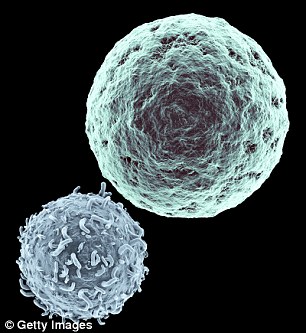

T-cell immunotherapy is created from T-cells bottom left in left image) – white blood cells that normally fight off viruses and bacteria. These are removed from the patient and genetically tweaked to recognise and attack their cancer. The genetically-modified cells are then grown in their millions in a lab before being infused back into the patient, where they hunt down cancer cells (right)
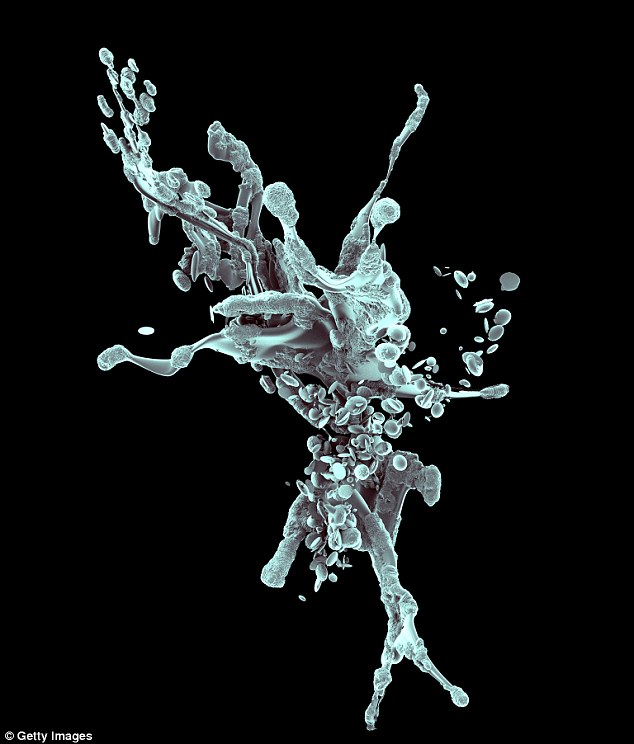
The cancer cells are then destroyed. Researchers likened the therapy to a vaccine that gives protection for life against an infection. Scientists around the world are now perfecting the technique
Professor Daniel Davis, a Manchester University expert on the immune system, described the study as ‘an important advance’.
He said: ‘The implication is that infusing genetically-modified versions of these particular T-cells could provide a long-lasting immune response. Immunotherapy has great potential to revolutionise cancer treatments and this study shows which type of T-cells might be especially useful to manipulate.’
A second study, also presented at the conference in Washington DC, reinforced the potential of T-cell immunotherapy.
When scientists at the Fred Hutchinson Cancer Research Centre in Seattle gave genetically-modified T-cells to leukaemia patients with months to live, the cancer disappeared in 94 per cent of cases. Patients with other blood cancers saw response rates of greater than 80 per cent, with more than half experiencing complete remission.
Researcher Dr Stanley Riddell said: ‘These are patients that have failed [every other treatment].
‘Most patients in our trial would be projected to have two to five months to live.
'This is extraordinary... unprecedented in medicine to get response rates in this range in these very advanced patients.
BABY GIRL'S MIRACLE RECOVERY

Hope: Layla Richards had the treatment last year
Little Layla Richards was given a T-cell treatment so experimental it had only been tested on mice.
The baby, from north London, had one of the worst cases of leukaemia her doctors had seen, and when all other therapies failed, her parents were told to expect the worst.
But they refused to give up and, last summer, when Layla was one, doctors at Great Ormond Street Hospital gave her an infusion of 50million cells genetically engineered to hunt and kill her cancer.
Her mother Lisa Foley, 27, said: ‘We didn’t want to accept palliative care and so we asked doctors to try anything for our daughter, even if it hadn’t been tried before.’
Father Ashleigh Richards, 30, added: ‘It was scary to think the treatment had never been used in a human before but even with the risks there was no doubt we wanted to try.’
The treatment wiped out Layla’s cancer. It is too early to say she is cured, but doctors have described her recovery as a ‘near miracle’.
‘We have a long way to go. The response is not always durable, some of these patients do relapse … but the early data is unprecedented.’
Professor Dirk Busch, a T-cell researcher at the Technical University of Munich, said: ‘We have now for the first time genetically engineered T-cells in patients.
‘A couple of years ago, nobody would have expected that they would work so nicely, that they would survive so nicely. That opens the door for getting more creative and making better cells.’
The treatment is not without its challenges, including side-effects that can be severe and even fatal. Success so far has been in leukaemia and other ‘liquid’ cancers, rather than prostate, breast and other tumours that form lumps.
Getting T-cells deep inside solid tumours will be difficult. Cost is also an issue, as the treatment is tailored to individual patients.
Cancer Research UK’s Dr Kat Arney said it was an ‘exciting prospect’.
She stressed that it ‘doesn’t yet work for all patients … we still need more results from more trials … but there’s a lot of hope this type of therapy could save lives’.
‘Like a vaccine that protects for life.’
#1: A K A Stone To: cranky (#0)
A K A Stone posted on 2016-02-16 08:41:57 Reply Private Reply
#2: cranky To: A K A Stone (#1)
It sounds very promising.
I hope it's not not another government scam like 'climate warming'.
cranky posted on 2016-02-16 09:08:46 Reply Private Reply
#3: A Pole To: cranky (#0)
A Pole posted on 2016-02-16 09:43:24 Reply Private Reply
#4: sneakypete To: cranky (#0)
Try to control your enthusiasm,Doc! You don't want people to think you are a wild-eyed dreamer,do you?
This is really huge. I've been really excited about this stuff since I started reading about Nanotechnology is Issac Asimov's Science Fiction and Fact magazine 20 years ago.
BTW,any of you out there that have any intelligent,or maybe even semi-intelligent children maybe 12-14 years old or older,I can't think of a better gift to give them than a 1 year subscription to that "tv digest" sized magazine. It is primarily science fiction short stories,but also has science facts and predictions,like the one I read about nano-technology. The short stories can open their minds to the world of possibilities,and the science fact articles are written at a layman's level of understanding,so even a bright child of 12 or so can get an inkling of what is being discussed without getting bogged down in incomprehensible details understandable only by PHD's.
In MY opinion there is no question that one day within the next 20 years or so if diabetes (for example) runs in your family that you will be able to take your children to a local clinic and have both you and your children given an injection like a flue shot,and never again have to worry about it because this type of technology doesn't treat symptoms of diseases,it alters your body chemistry right at the cellular level.
Insurance companies are going to love this. Corporate hospitals,not so much. Big Pharma,not so much. Look for Big Hospitals and Big Pharma to try to buy up patents to keep this type of medicine off the market to all but the very wealthy,such as the people who own Big Pharma and Big Hospitals.
sneakypete posted on 2016-02-16 09:57:32 Reply Private Reply
#5: VxH To: sneakypete (#4)
Was PK Dick a subscriber before or after he started seeing pink lights from god?
VxH posted on 2016-02-16 10:34:27 Reply Private Reply
#6: cranky To: A Pole (#3)
I've read R&D in the medical field is prohibitively expensive.
Who will finance it?
cranky posted on 2016-02-16 10:49:53 Reply Private Reply
#7: cranky To: sneakypete (#4)
No kidding?
Looks like you may get to see it happen.
cranky posted on 2016-02-16 10:52:49 Reply Private Reply
#8: sneakypete To: VxH (#5)
Beats me. You seem to the one that knows about him.
sneakypete posted on 2016-02-16 10:59:55 Reply Private Reply
#9: sneakypete To: cranky (#7)
LOL! They had better be quick.
Chances are I will never benefit from it. Too old,and new and expensive medical care is always given to the young and productive.
Triage always rules in the medical community unless you are very wealthy and/or very influential.
Or,I guess,very lucky in weird way so you are so close to death you qualify as a test monkey for researchers.
Still,it's good to know that future generations will benefit from it.
sneakypete posted on 2016-02-16 11:04:42 Reply Private Reply
#10: cranky To: sneakypete (#9)
I know what you mean.
I've about given up on my jetpack and my flying car and my house on Mars.
cranky posted on 2016-02-16 11:11:03 Reply Private Reply
#11: A Pole To: cranky (#6)
Usually it is financed by the government.
But if it is succesfull it is given to private interests so they can profit and claim moral credit
A Pole posted on 2016-02-16 12:25:35 Reply Private Reply
#12: cranky To: A Pole (#11)
I hope not Martin Shkrel.
cranky posted on 2016-02-16 18:33:25 Reply Private Reply
#13: TheFireBert To: cranky, ALL (#0)
Isn't this the theme of the "Resident Evil" films?
TheFireBert posted on 2016-02-17 12:45:54 Reply Private Reply
#14: cranky To: TheFireBert (#13)
I'm not familiar with the franchise.
But it's sort of like Fantastic Voyage.
cranky posted on 2016-02-17 14:58:38 Reply Private Reply
#15: SOSO To: cranky (#14)
I love the scene where Steven Boyd cops a feel or two off of Raquel Welch.
SOSO posted on 2016-02-17 15:09:59 Reply Private Reply
#16: cranky To: SOSO (#15)
Someone had to remove the micro-organisms.
And he was was the star.
cranky posted on 2016-02-18 16:20:46 Reply Private Reply
#17: SOSO To: cranky (#16)
I didn't know that micro-organisms only attacked females and only from the waist up. Had they distributed all over the body we may have seen the first big screen micro-orgasms.
SOSO posted on 2016-02-18 19:36:57 Reply Private Reply