
United States News
See other United States News Articles
Title: Innocent Woman Calls 911 After an Accident, Cop Shows Up, Sexually Assaults and Arrests Her
Source:
Free Thought Project/KUTV
URL Source: http://thefreethoughtproject.com/vi ... s-arrests/#83zRK5FcH3KDvMil.99
Published: Oct 13, 2016
Author: Matt Agorist
Post Date: 2016-10-13 10:39:33 by Deckard
Keywords: None
Views: 1250
Comments: 3
Layton, UT — On July 25, 2106, Amanda Houghton was hit from behind in her vehicle by another motorist — so, she called 911 — for help. However, help was the last thing she would receive. Instead, she was sexually assaulted and falsely arrested. After the accident, Houghton was naturally shaken up as she’d just been hit by a car traveling at 30 mph as she was sitting still. Her car was totaled. Instead of realizing that Houghton could be in a mild state of shock, officer G Schatzman mistook her nervousness for intoxication. Again, instead of providing the help Houghton called for, Schatzman began to treat her as a criminal. According to KUTV, a police report by officer G Schatzman indicates Amanda exhibited odd behavior and gave “short quick answers to questions and she was speaking rapidly. Amanda was unable to stand still and seemed to be making jerky movements,” when he came into contact with her. Schatzman, who just knew that this innocent woman was a dangerous criminal, issued a field sobriety test. Houghton failed the field sobriety test, but this is common, especially among those who’ve just been in a traumatic accident. Houghton was then placed in handcuffs and arrested for DUI. “I was shocked. Who arrests a sober person for DUI?” she said. After being falsely accused of DUI and placed in handcuffs, Schatzman began to grope his victim. In the video, we can clearly see Schatzman prodding at the innocent woman’s breasts. When Houghton pulls away in a natural reaction to being sexually assaulted, Schatzman yanks her around like a ragdoll. This pulling away by Houghton would later lead to a charge of resisting arrest. In Police State USA pulling away from your armed captor who’s groping your private parts is a punishable offense. “Don’t touch me!” says Houghton after this cop fondled her breasts. “I can search you,” says Schatzman, asserting his state-granted power to legally sexually assault women in the name of falsely arresting them. Naturally, the police department is standing behind their officer’s decision to grope Houghton too. Lt. Travis Lyman said his officer did the arrest by the book and had reasonable suspicion that Amanda was DUI. He said the search around her breasts is taught in the police academy. Male officers do it when a female officer is not around, according to KUTV. “That’s standard practice. Anytime someone gets arrested they are going to be searched,” he said. However, police had no reason to arrest her. After being kidnapped by the armed man who previously sexually assaulted her, Houghton was given a blood test by police. No drugs or alcohol were found in her system. Just for good measure, Houghton was brought to the hospital and given a second blood test — also negative. Houghton has since retained counsel and is pursuing legal action against her aggressors. In spite of the blood test showing this cop had no reason to arrest her, the city is refusing to drop the charges. Jonathan Nish, Houghton’s criminal defense attorney, is pushing for the charges to be dropped. “I don’t’ believe they should have administered the field sobriety tests at all in this case,” he said. Houghton also retained another attorney to help her seek legal action. Attorney Robert Sykes, who has put the City of Layton on notice that they are seeking legal action, said the officer had no basis for the DUI suspicion in the first place, and the search of her person was a violation of Houghton’s constitutional rights. “I think this amounted to an unconstitutional search of a woman without a necessity to do so,” he said. As you watch the video below, remember that this woman had committed no crime. She had harmed no one. And, she was the one who called the police for help.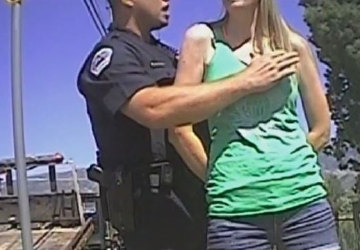
Post Comment Private Reply Ignore Thread
Top • Page Up • Full Thread • Page Down • Bottom/Latest
#1. To: Deckard (#0)
Fondled? Watch the video. He was careful to only use his index finger and he probed around her breast.
Search Incident to Arrest.—The common-law rule permitting searches of the person of an arrestee as an incident to the arrest has occasioned little controversy in the Court.216 The Court has even upheld a search incident to an illegal (albeit not unconstitutional) arrest.8 The dispute has centered around the scope of the search. Since it was the stated general rule that the scope of a warrantless search must be strictly tied to and justified by the circumstances which rendered its justification permissible, and since it was the rule that the justification of a search of the arrestee was to prevent destruction of evidence and to prevent access to a weapon,217 it was argued to the court that a search of the person of the defendant arrested for a traffic offense, which discovered heroin in a crumpled cigarette package, was impermissible, inasmuch as there could have been no destructible evidence relating to the offense for which he was arrested and no weapon could have been concealed in the cigarette package. The Court rejected this argument, ruling that "no additional justification" is required for a custodial arrest of a suspect based on probable cause.218 216 Weeks v. United States, 232 U.S. 383, 392 (1914); Carroll v. United States, 267 U.S. 132, 158 (1925); Agnello v. United States, 269 U.S. 20, 30 (1925). 8 Virginia v. Moore, 128 S. Ct. 1598 (2008) (holding that, where an arrest for a minor offense is prohibited by state law, the arrest will not violate the Fourth Amendment if it was based on probable cause). 217 Terry v. Ohio, 392 U.S. 1, 19 (1968); Chimel v. California, 395 U.S. 752, 762, 763 (1969). 218 United States v. Robinson, 414 U.S. 218, 235 (1973). See also id. at 237-38 (Justice Powell concurring). The Court applied the same rule in Gustafson v. Florida, 414 U.S. 260 (1973), involving a search of a motorist's person following his custodial arrest for an offense for which a citation would normally have issued. Unlike the situation in Robinson, police regulations did not require the Gustafson officer to take the suspect into custody, nor did a departmental policy guide the officer as to when to conduct a full search. The Court found these differences inconsequential, and left for another day the problem of pretextual arrests in order to obtain basis to search. Soon thereafter, the Court upheld conduct of a similar search at the place of detention, even after a time lapse between the arrest and search. United States v. Edwards, 415 U.S. 800 (1974). However, the Justices have long found themselves embroiled in argument about the scope of the search incident to arrest as it extends beyond the person to the area in which the person is arrested, most commonly either his premises or his vehicle. Certain early cases went both ways on the basis of some fine distinctions,219 but in Harris v. United States,220 the Court approved a search of a four-room apartment pursuant to an arrest under warrant for one crime and in which the search turned up evidence of another crime. A year later, in Trupiano v. United States, 221 a raid on a distillery resulted in the arrest of a man found on the premises and a seizure of the equipment; the Court reversed the conviction because the officers had had time to obtain a search warrant and had not done so. "A search or seizure without a warrant as an incident to a lawful arrest has always been considered to be a strictly limited right. It grows out of the inherent necessities of the situation at the time of the arrest. But there must be something more in the way of necessity than merely a lawful arrest." 222 This decision was overruled in United States v. Rabinowitz, 223 in which officers arrested defendant in his one-room office pursuant to an arrest warrant and proceeded to search the room completely. The Court observed that the issue was not whether the officers had the time and opportunity to obtain a search warrant but whether the search incident to arrest was reasonable. Though Rabinowitz referred to searches of the area within the arrestee's "immediate control,"224 it provided no standard by which this area was to be determined, and extensive searches were permitted under the rule.225 219 Compare Marron v. United States, 275 U.S. 192 (1927), with Go-Bart Importing Co. v. United States, 282 U.S. 344 (1931), and United States v. Lefkowitz, 285 U.S. 452 (1932). 220 331 U.S. 145 (1947). 221 334 U.S. 699 (1948). 222 Id. at 708. 223 339 U.S. 56 (1950). 224 Id. at 64. 225 Cf. Chimel v. California, 395 U.S. 752, 764-6 5 & n.10 (1969). But in Kremen v. United States, 353 U.S. 346 (1957), the Court held that the seizure of the entire contents of a house and the removal to F.B.I. offices 200 miles away for examination, pursuant to an arrest under warrant of one of the persons found in the house, was unreasonable. In decisions contemporaneous to and subsequent to Chimel, applying pre- Chimel standards because that case was not retroactive, Williams v. United States, 401 U.S. 646 (1971), the Court has applied Rabinowitz somewhat restrictively. See Von Cleef v. New Jersey, 395 U.S. 814 (1969), which followed Kremen; Shipley v. California, 395 U.S. 818 (1969), and Vale v. Louisiana, 399 U.S. 30 (1970) (both involving arrests outside the house with subsequent searches of the house); Coolidge v. New Hampshire, 403 U.S. 443, 455-5 7 (1971). Substantially extensive searches were, however, approved in Williams v. United States, 401 U.S. 646 (1971), and Hill v. California, 401 U.S. 797 (1971). In Chimel v. California, 226 however, a narrower view was asserted, the primacy of warrants was again emphasized, and a standard by which the scope of searches pursuant to arrest could be ascertained was set out. "When an arrest is made, it is reasonable for the arresting officer to search the person arrested in order to remove any weapons that the latter might seek to use in order to resist arrest or effect his escape. Otherwise, the officer's safety might well be endangered, and the arrest itself frustrated. In addition, it is entirely reasonable for the arresting officer to search for and seize any evidence on the arrestee's person in order to prevent its concealment or destruction. And the area into which an arrestee might reach in order to grab a weapon or evidentiary items must, of course, be governed by a like rule. A gun on a table or in a drawer in front of someone who is arrested can be as dangerous to the arresting officer as one concealed in the clothing of the person arrested. There is ample justification, therefore, for a search of the arrestee's person and the area 'within his immediate control'—construing that phrase to mean the area from within which he might gain possession of a weapon or destructible evidence." "There is no comparable justification, however, for routinely searching any room other than that in which an arrest occurs—or, for that matter, for searching through all the desk drawers or other closed or concealed areas in that room itself. Such searches, in the absence of well-recognized exceptions, may be made only under the authority of a search warrant."227 Although the viability of Chimel had been in doubt for some time as the Court refined and applied its analysis of reasonable and justifiable expectations of privacy,228 it has in some but not all contexts survived the changed rationale. Thus, in Mincey v. Arizona,229 the Court rejected a state effort to create a "homicide-scene" exception for a warrantless search of an entire apartment extending over four days. The occupant had been arrested and removed and it was true, the Court observed, that a person legally taken into custody has a lessened right of privacy in his person, but he does not have a lessened right of privacy in his entire house. And, in United States v. Chadwick,230 emphasizing a person's reasonable expectation of privacy in his luggage or other baggage, the Court held that, once police have arrested and immobilized a suspect, validly seized bags are not subject to search without a warrant.231 Police may, however, in the course of jailing an arrested suspect conduct an inventory search of the individual's personal effects, including the contents of a shoulder bag, since "the scope of a station- house search may in some circumstances be even greater than those supporting a search immediately following arrest."232 226 395 U.S. 752 (1969). 227 Id. at 762-63. 228 See, e.g., Coolidge v. New Hampshire, 403 U.S. 443, 492, 493, 510 (1971), in which the four dissenters advocated the reasonableness argument rejected in Chimel. 229 437 U.S. 385, 390-9 1 (1978) Accord, Flippo v. West Virginia, 528 U.S. 11 (1999) (per curiam). 230 433 U.S. 1 (1977). Defendant and his luggage, a footlocker, had been removed to the police station, where the search took place. 231 If, on the other hand, a sealed shipping container had already been opened and resealed during a valid customs inspection, and officers had maintained surveil-lance through a "controlled delivery" to the suspect, there is no reasonable expectation of privacy in the contents of the container and officers may search it, upon the arrest of the suspect, without having obtained a warrant. Illinois v. Andreas, 463 U.S. 765 (1983). 232 Illinois v. LaFayette, 462 U.S. 640, 645 (1983) (inventory search) (following South Dakota v. Opperman, 428 U.S. 364 (1976)). Similarly, an inventory search of an impounded vehicle may include the contents of a closed container. Colorado v. Bertine, 479 U.S. 367 (1987). Inventory searches of closed containers must, however, be guided by a police policy containing standardized criteria for exercise of discretion. Florida v. Wells, 495 U.S. 1 (1990). Still purporting to reaffirm Chimel, the Court in New York v. Belton233 held that police officers who had made a valid arrest of the occupant of a vehicle could make a contemporaneous search of the entire passenger compartment of the automobile, including containers found therein. Believing that a fairly simple rule understandable to authorities in the field was desirable, the Court ruled "that articles inside the relatively narrow compass of the passenger compartment of an automobile are in fact generally, if not inevitably, within 'the area into which an arrestee might reach in order to grab a weapon or evidentiary ite[m]."'234 Belton was “widely understood to allow a vehicle search incident to the arrest of a recent occupant even if there is no possibility the arrestee could gain access to the vehicle at the time of the search.”9 In Arizona v. Gant,10 however, the Court disavowed this understanding of Belton11 and held that “[p]olice may search a vehicle incident to a recent occupant's arrest only if the arrestee is within reaching distance of the passenger compartment at the time of the search or it is reasonable to believe that the vehicle contains evidence of the offense of arrest.”12 233 453 U.S. 454 (1981). 234 Id. at 460 (quoting Chimel v. California, 395 U.S. 752, 763 (1969)). In this particular instance, Belton had been removed from the automobile and handcuffed, but the Court wished to create a general rule removed from the fact-specific nature of any one case. "'Container' here denotes any object capable of holding another object. It thus includes closed or open glove compartments, consoles, or other receptacles located anywhere within the passenger compartment, as well as luggage, boxes, bags, clothing, and the like. Our holding encompasses only the interior of the passenger compartment of an automobile and does not encompass the trunk." Id. at 460-61 n.4. 9 Arizona v. Gant, 129 S. Ct. 1710, 1718 (2009). 10 129 S. Ct. 1710 (2009). 11 “To read Belton as authorizing a vehicle search incident to every recent occupant's arrest would . . . untether the rule from the justifications underlying the Chimel exception …” 129 S. Ct. at 1719. 12 129 S. Ct. at 1723. Justice Alito, in a dissenting opinion joined by Chief Justice Roberts and Justice Kennedy and in part by Justice Breyer, wrote that “there can be no doubt that” the majority had overruled Belton. Id. at 1726. Chimel has, however, been qualified by another consideration. Not only may officers search areas within the arrestee's immediate control in order to alleviate any threat posed by the arrestee, but they may extend that search if there may be a threat posed by "unseen third parties in the house." A "protective sweep" of the entire premises (including an arrestee's home) may be undertaken on less than probable cause if officers have a "reasonable belief," based on "articulable facts," that the area to be swept may harbor an individual posing a danger to those on the arrest scene.235 235 Maryland v. Buie, 494 U.S. 325, 334 (1990). This "sweep" is not to be a full-blown, "top-to-bottom" search, but only "a cursory inspection of those spaces where a person may be found." Id. at 335- 36. http://law.justia.com/constitution/us/amendment-04/14-search-incident-to- arrest.html .
Does that include groping her tits? The arrest itself was based on a false charge. The woman had just been hit from behind by another vehicle, was injured and incoherent. If the cop was too much of a prick to realize that and try to her get her some medical attention instead of harassing her, then he has no business being a cop. Oh, BTW - we already have one nolu spam here. Buh-bye bozo. “Don’t touch me!” says Houghton after this cop fondled her breasts."
#2. To: Deckard (#0)
Houghton also retained another attorney to help her seek legal action. Attorney Robert Sykes, who has put the City of Layton on notice that … the search of her person was a violation of Houghton’s constitutional rights. “I think this amounted to an unconstitutional search of a woman without a necessity to do so,” he said.
Violation of constitutional rights? Under the Fourth Amendment to the U.S. Constitution, police may engage in "reasonable" searches and seizures. It is “reasonable” that police may search your person and the immediate surroundings without a warrant when they are placing you under arrest.Search Incident to Arrest
#3. To: Gatlin (#2)
police may search your person and the immediate surroundings without a warrant when they are placing you under arrest.
“Truth is treason in the empire of lies.” - Ron Paul

"America is at that awkward stage. It's too late to work within the system, but too early to shoot the bastards."
Top • Page Up • Full Thread • Page Down • Bottom/Latest
[Home] [Headlines] [Latest Articles] [Latest Comments] [Post] [Mail] [Sign-in] [Setup] [Help] [Register]