
[Home]  [Headlines]  [Latest Articles]  [Latest Comments]  [Post]  [Mail]  [Sign-in]  [Setup]  [Help]  [Register] 

"Tim Walz Wants the Worst"

Border Patrol Agents SMASH Window and Drag Man from Car in Minnesota Chaos

"Dear White Liberals: Blacks and Hispanics Want No Part of Your Anti-ICE Protests"

"The Silliest Venezuela Take You Will Read Today"

Michael Reagan, Son of Ronald Reagan, Dies at 80

Patel: "Minnesota Fraud Probes 'Buried' Under Biden"

"There’s a Word for the West’s Appeasement of Militant Islam"

"The Bondi Beach Jihad: Sharia Supremacism and Jew Hatred, Again"

"This Is How We Win a New Cold War With China"

"How Europe Fell Behind"

"The Epstein Conspiracy in Plain Sight"

Saint Nicholas The Real St. Nick

Will Atheists in China Starve Due to No Fish to Eat?

A Thirteen State Solution for the Holy Land?

US Sends new Missle to a Pacific ally, angering China and Russia Moscow and Peoking

DeaTh noTice ... Freerepublic --- lasT Monday JR died

"‘We Are Not the Crazy Ones’: AOC Protests Too Much"

"Rep. Comer to Newsmax: No Evidence Biden Approved Autopen Use"

"Donald Trump Has Broken the Progressive Ratchet"

"America Must Slash Red Tape to Make Nuclear Power Great Again!!"

"Why the DemocRATZ Activist Class Couldn’t Celebrate the Cease-Fire They Demanded"

Antifa Calls for CIVIL WAR!

British Police Make an Arrest...of a White Child Fishing in the Thames

"Sanctuary" Horde ASSAULTS Chicago... ELITE Marines SMASH Illegals Without Mercy

Trump hosts roundtable on ANTIFA

What's happening in Britain. Is happening in Ireland. The whole of Western Europe.

"The One About the Illegal Immigrant School Superintendent"

CouldnÂ’t believe he let me pet him at the end (Rhino)

Cops Go HANDS ON For Speaking At Meeting!

POWERFUL: Charlie Kirk's final speech delivered in South Korea 9/6/25

2026 in Bible Prophecy

2.4 Billion exposed to excessive heat

🔴 LIVE CHICAGO PORTLAND ICE IMMIGRATION DETENTION CENTER 24/7 PROTEST 9/28/2025

Young Conservative Proves Leftist Protesters Wrong

England is on the Brink of Civil War!

Charlie Kirk Shocks Florida State University With The TRUTH

IRL Confronting Protesters Outside UN Trump Meeting

The UK Revolution Has Started... Brit's Want Their Country Back

Inside Paris Dangerous ANTIFA Riots

Rioters STORM Chicago ICE HQ... "Deportation Unit" SCRAPES Invaders Off The Sidewalk

She Decoded A Specific Part In The Bible

Muslim College Student DUMBFOUNDED as Charlie Kirk Lists The Facts About Hamas

Charlie Kirk EVISCERATES Black Students After They OPENLY Support “Anti-White Racism” HEATED DEBATE

"Trump Rips U.N. as Useless During General Assembly Address: ‘Empty Words’"

Charlie Kirk VS the Wokies at University of Tennessee

Charlie Kirk Takes on 3 Professors & a Teacher

British leftist student tells Charlie Kirk facts are unfair

The 2 Billion View Video: Charlie Kirk's Most Viewed Clips of 2024

Antifa is now officially a terrorist organization.

The Greatness of Charlie Kirk: An Eyewitness Account of His Life and Martyrdom


Status: Not Logged In; Sign In

United States News
See other United States News Articles

Title: An Immigration Lawyer On The Truth About Birthright Citizenship
Source: TPM Cafe: Opinion
URL Source: http://talkingpointsmemo.com/cafe/i ... -lawyer-birthright-citizenship
Published: Aug 20, 2015
Author: David Leopold
Post Date: 2015-08-20 18:36:28 by nolu chan
Keywords: None
Views: 866
Comments: 16

An Immigration Lawyer On The Truth About Birthright Citizenship

By David Leopold
TPM Cafe: Opinion
Published August 19, 2015, 9:55 AM EDT

GOP front-runner Donald Trump’s immigration plan, released on Sunday, can be easily summarized in the candidate’s own four words: “They have to go.” The plan is little more than a nativist wish list, with a bold kicker: an end to so-called “birthright citizenship,” the constitutional rule that a child born in and under the jurisdiction of the U.S. is a citizen.

This position is not new. Over the years, there have been attempts by restrictionists to challenge birthright citizenship. In the 1800s, the focus was Chinese immigrants. Of late, the effort has been focused on Latino immigrants, led in Congress by Rep. Steve King (R-IA) and, more recently, Sen. David Vitter (R-LA), who believe they can end this constitutional provision with legislation. Earlier this year, Vitter tried to attach an amendment to the Justice for Victims of Trafficking Act, which provided that a child born in the United States would be considered a citizen only if at least one parent is a citizen, is a lawful permanent resident, or has served in the military.

Now, opposing birthright citizenship may emerge as a kind of litmus test for Republicans; earlier this month, New Jersey Gov. Chris Christie said we should “re-examine the 14th Amendment.” But before that happens, let’s get a few facts straight.

Trump claims that birthright citizenship must end because it’s the “biggest magnet for illegal immigration”— it attracts illegal immigrants using their “anchor babies” to reap the benefits of U.S. citizenship. In fact, being the undocumented parent of a U.S. citizen bestows no legal right to even be in the country, let alone to a green card or citizenship—just ask the thousands of undocumented parents deported and barred from the U.S. each day by the Department of Homeland Security. The law requires that to sponsor an undocumented parent for a green card a child must first reach the age of 21. But at that point—more than two decades after arrival—an undocumented parent who entered illegally is not eligible to apply for a green card in the U.S. The parent must leave and apply abroad. And once the parent departs the U.S., another part of the law bans his or her return for 10 years.

The “magnet” to which Trump refers is an arduous 31-year-long slog to legal status for the undocumented parent: 21 years for the child to be able to sponsor the parent and 10 years of banishment from the U.S. because of their previously unlawful presence. Perhaps that’s why Trump and others who oppose birthright citizenship have failed to produce any evidence of hordes of pregnant women streaming across the border illegally (or even legally) to give birth. There’s no evidence that this is a widespread phenomenon—for instance, less than 2 percent of Arizona babies were born to nonresident mothers in 2010.

But facts don’t seem to matter to Trump. So it’s worth asking: What would it take for the United States to end constitutional citizenship?

There are those who believe that birthright citizenship could be eviscerated by a mere statutory tweak. The theory is founded on the claim that the 14th Amendment was ratified to grant citizenship to recently freed slaves and not to every person born in the U.S. If the law is changed to hold that the children of undocumented immigrants are not within the “jurisdiction” of the U.S. — as required by the 14th Amendment — then the children of undocumented immigrants may be deprived of citizenship at birth.

But while the Supreme Court has not directly addressed the question of whether the children of undocumented immigrants are eligible for birthright citizenship, Trump’s proposal would most likely require a constitutional amendment. That’s because the 14th Amendment grants citizenship to "all persons born or naturalized in the United States, and subject to” its jurisdiction. Directly overruling the infamous Dred Scott decision and codifying the common law rule that a person born within the jurisdiction of the U.S. is an American citizen, the 14th Amendment forms the cornerstone of American civil rights by ensuring due process and equal protection to all persons.

What would America look like without constitutional citizenship? Ironically, the likely result would be to make America’s broken immigration system even more shattered and at great humanitarian cost. According to the Migration Policy Institute (pdf), repeal of birthright citizenship would lead to a dramatic increase in the number of unauthorized children living in the U.S. — as many as 24 million by 2050. The Immigration Policy Center argues that “[r]epealing birthright citizenship would create an underclass of unauthorized immigrants who, through no fault of their own, would be forced to live in the margins of U.S. society, would not have access to health care and basic services, would be vulnerable to exploitation and abuse, and would be at constant risk of deportation.”

When it comes down to it, the Citizenship Clause of the 14th Amendment has very little to do with immigration; it is fundamentally focused on the preservation of civil rights. Trump’s extremist proposal to end birthright citizenship — whether by elimination or reinterpretation of the Citizenship Clause — comes at the grave cost of abridging civil rights, even hearkening back to the days of Dred Scott, when people were viewed as commodities to be bought and sold. Rather than challenge a constitutional provision that reversed a notorious Supreme Court decision, the effect of which was to dehumanize and deprive African-Americans of U.S. citizenship, Trump would better serve the GOP, and this nation, by proposing serious immigration policy solutions.

David Leopold practices immigration law in Cleveland. He is past president of the American Immigration Lawyers Association.
Post Comment   Private Reply   Ignore Thread  


TopPage UpFull ThreadPage DownBottom/Latest

#1. To: All (#0)

That’s because the 14th Amendment grants citizenship to "all persons born or naturalized in the United States, and subject to” its jurisdiction.

No it doesn't...

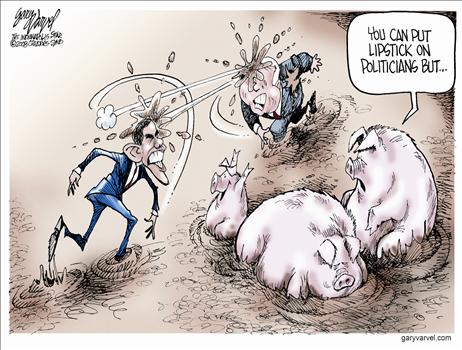
“Let me see which pig "DON'T" I want to vote for, the one with or without lipstick??" Hmmmmm...

CZ82  posted on  2015-08-20   18:41:20 ET  Reply   Trace   Private Reply  


#2. To: nolu chan (#0)

"The “magnet” to which Trump refers is an arduous 31-year-long slog to legal status for the undocumented parent"

The parent could care less about their legal status under Obama. He's not going to deport them.

Trump is referring to the benefits "magnet" of the child being a U.S. citizen at birth. Illegal immigrants can obtain welfare benefits such as Medicaid and food stamps on behalf of their U.S.-born children. Plus the child gets all the benefits of being a citizen including free education.

THAT'S the magnet.

misterwhite  posted on  2015-08-20   19:48:18 ET  Reply   Trace   Private Reply  


#3. To: nolu chan (#0)

"that’s why Trump and others who oppose birthright citizenship have failed to produce any evidence of hordes of pregnant women streaming across the border illegally (or even legally) to give birth."

Well, we currently have 4 million anchor babies in the U.S. To me, that's evidence of hordes of pregnant women who streamed across the border illegally to give birth.

misterwhite  posted on  2015-08-20   19:56:04 ET  Reply   Trace   Private Reply  


#4. To: nolu chan (#0) (Edited)

When it comes down to it, the Citizenship Clause of the 14th Amendment has very little to do with immigration; it is fundamentally focused on the preservation of civil rights.

In this case it is being contorted to be used as civil rights for a massive invasion force of genetic primitives with primary allegiance to themselves and a reconquista la raza culture.

We will one day wake up to find barbarian invaders have more rights than we do.

rlk  posted on  2015-08-20   20:44:00 ET  Reply   Trace   Private Reply  


#5. To: nolu chan (#0)

If birthright citizenship was granted to everyone born in the US then the amendment would read like this :'All persons born or naturalized in the United States, are citizens of the United States and of the state wherein they reside'. The words 'subject to the jurisdiction 'would not be needed .

But the truth is that the 14th is not a blanket mandate on birthright citizenship. The 14th in Sec 5 makes it clear that Congress has the 'power to enforce, by appropriate legislation, the provisions of this article'. Article 1 Sec 8 of the constitution also gives Congress the power to 'establish a uniform rule of naturalization'.

The reason 'subject to the jurisdiction' was added to the amendment was to make it clear that States no longer had the power to decide the matter .

The same Congress that adopted the 14th also passed Sec. 1992 of U.S. Revised Statutes which stated that “All persons born in the United States and not subject to any foreign power, excluding Indians not taxed, are declared to be citizens of the United States.” Who are the subjects of foreign powers ? Well aliens of course.

In 1866, Senator Jacob Howard made the intent of the 14th Amendment clear :

"Every person born within the limits of the United States, and subject to their jurisdiction, is by virtue of natural law and national law a citizen of the United States. This will not, of course, include persons born in the United States who are foreigners, aliens, who belong to the families of ambassadors or foreign ministers accredited to the Government of the United States, but will include every other class of persons. It settles the great question of citizenship and removes all doubt as to what persons are or are not citizens of the United States. This has long been a great desideratum in the jurisprudence and legislation of this country."

Quis custodiet ipsos custodes?

tomder55  posted on  2015-08-20   21:25:46 ET  Reply   Trace   Private Reply  


#6. To: CZ82 (#1)

No it doesn't...

Yes it does ... exactly what it says it does.

nolu chan  posted on  2015-08-21   3:01:22 ET  Reply   Trace   Private Reply  


#7. To: misterwhite (#2)

The parent could care less about their legal status under Obama. He's not going to deport them.

This did not start with Obama. They are called anchor babies because the parents a permitted to stay, even in defiance of the law. The magnet is the parents being treated like citizens in almost every way. If the parents knew they would be deported, according to law, and be denied benefits, they would stop coming.

There is no law that makes a baby an anchor baby.

nolu chan  posted on  2015-08-21   3:07:55 ET  Reply   Trace   Private Reply  


#8. To: tomder55 (#5)

If birthright citizenship was granted to everyone born in the US then the amendment would read like this :'All persons born or naturalized in the United States, are citizens of the United States and of the state wherein they reside'. The words 'subject to the jurisdiction 'would not be needed .

As I have made clear before, dropping out "subject to the jurisdiction" would confer U.S. citizenship of the children of foreign diplomats.

The reason 'subject to the jurisdiction' was added to the amendment was to make it clear that States no longer had the power to decide the matter .

This is just wrong. The congressional debate is clear who was to be included and excluded by "subject to the jurisdiction."

nolu chan  posted on  2015-08-21   3:13:50 ET  Reply   Trace   Private Reply  


#9. To: nolu chan (#8)

The congressional debate is clear who was to be included and excluded by "subject to the jurisdiction."

Senator Jacob Howard of Michigan proposed the addition of the phrase specifically because he wanted to make clear that the simple accident of birth in the United States was not sufficient to justify citizenship. "Every person born within the limits of the United States, and subject to their jurisdiction, is by virtue of natural law and national law a citizen of the United States. This will not, of course, include persons born in the United States who are foreigners, aliens, who belong to the families of ambassadors or foreign ministers accredited to the Government of the United States, but will include every other class of persons. It settles the great question of citizenship and removes all doubt as to what persons are or are not citizens of the United States. This has long been a great desideratum in the jurisprudence and legislation of this country."

John A. Bingham, chief architect of the 1st section of the 14th amendment said the proposed national law on citizenship was "simply declaratory of what is written in the Constitution, that every human being born within the jurisdiction of the United States of parents not owing allegiance to any foreign sovereignty is, in the language of your Constitution itself, a natural born citizen..."

Quis custodiet ipsos custodes?

tomder55  posted on  2015-08-21   6:40:54 ET  Reply   Trace   Private Reply  


#10. To: tomder55 (#9)

The congressional debate is clear who was to be included and excluded by "subject to the jurisdiction."

Senator Jacob Howard of Michigan proposed the addition of the phrase specifically because he wanted to make clear that the simple accident of birth in the United States was not sufficient to justify citizenship. "Every person born within the limits of the United States, and subject to their jurisdiction, is by virtue of natural law and national law a citizen of the United States. This will not, of course, include persons born in the United States who are foreigners, aliens, who belong to the families of ambassadors or foreign ministers accredited to the Government of the United States, but will include every other class of persons. It settles the great question of citizenship and removes all doubt as to what persons are or are not citizens of the United States. This has long been a great desideratum in the jurisprudence and legislation of this country."

John A. Bingham, chief architect of the 1st section of the 14th amendment said the proposed national law on citizenship was "simply declaratory of what is written in the Constitution, that every human being born within the jurisdiction of the United States of parents not owing allegiance to any foreign sovereignty is, in the language of your Constitution itself, a natural born citizen..."

“Let me see which pig "DON'T" I want to vote for, the one with or without lipstick??" Hmmmmm...

CZ82  posted on  2015-08-21   7:10:38 ET  (1 image) Reply   Trace   Private Reply  


#11. To: tomder55 (#5)

"Every person born within the limits of the United States, and subject to their jurisdiction, is by virtue of natural law and national law a citizen of the United States. This will not, of course, include persons born in the United States who are foreigners, aliens, who belong to the families of ambassadors or foreign ministers accredited to the Government of the United States, but will include every other class of persons. It settles the great question of citizenship and removes all doubt as to what persons are or are not citizens of the United States. This has long been a great desideratum in the jurisprudence and legislation of this country."

SHOUT IT!

"Every person born within the limits of the United States, and subject to their jurisdiction, is by virtue of natural law and national law a citizen of the United States. This will not, of course, include persons born in the United States who are foreigners, aliens, who belong to the families of ambassadors or foreign ministers accredited to the Government of the United States, but will include every other class of persons It settles the great question of citizenship and removes all doubt as to what persons are or are not citizens of the United States. This has long been a great desideratum in the jurisprudence and legislation of this country."

patriot wes  posted on  2015-08-21   8:06:03 ET  Reply   Trace   Private Reply  


#12. To: rlk (#4)

We will one day wake up to find barbarian invaders have more rights than we do.

And I am sure the tyrants in robes will declare this to not only be constitutional, but to insure the invaders DONT have more rights would require a constitutional amendment.

And some here would agree, simply because that is what the tyrants have ruled, ergo, it must be.

Dead Culture Watch  posted on  2015-08-21   11:30:00 ET  Reply   Trace   Private Reply  


#13. To: tomder55 (#9)

John A. Bingham, chief architect of the 1st section of the 14th amendment said the proposed national law on citizenship was "simply declaratory of what is written in the Constitution, that every human being born within the jurisdiction of the United States of parents not owing allegiance to any foreign sovereignty is, in the language of your Constitution itself, a natural born citizen..."

Representative John A. Bingham introduced the other parts of 14A in the House. The citizenship clause was not in it. The citizenship clause was introduced in the Senate by Senator Jacob Howard.

http://www.loc.gov/law/help/citizenship/fourteenth_amendment_citizenship.php

Citizenship is defined in the first clause of the first section of the Fourteenth Amendment as:

All persons born or naturalized in the United States, and subject to the jurisdiction thereof, are citizens of the United States and the State wherein they reside.

The amendment's language was drafted by the Joint Committee on Reconstruction. The language defining citizenship was not in the introduced version of the amendment (H. J. Res. 127), but, was moved by Senator Howard of Michigan on May 30, 1866. It was adopted by the Senate that day and later adopted by the House. The Senate's consideration of the Howard language can be found in volume 36 of the Congressional Globe, pages 2890 to 2897.

As for your arcane ideas about what "subject to the jurisdiction" means with respect to illegal aliens, they are not shared by the U.S. Supreme Court:

- - - - - - - - -

U.S. Supreme Court

PLYLER v. DOE, 457 U.S. 202 (1982)

457 U.S. 202

PLYLER, SUPERINTENDENT, TYLER INDEPENDENT SCHOOL DISTRICT, ET AL. v. DOE, GUARDIAN, ET AL.

APPEAL FROM THE UNITED STATES COURT OF APPEALS FOR THE FIFTH CIRCUIT

No. 80-1538.

Argued December 1, 1981
Decided June 15, 1982 *

Held: A Texas statute which withholds from local school districts any state funds for the education of children who were not “legally admitted” into the United States, and which authorizes local school districts to deny enrollment to such children, violates the Equal Protection Clause of the Fourteenth Amendment. Pp. 210-230.

(a) The illegal aliens who are plaintiffs in these cases challenging the statute may claim the benefit of the Equal Protection Clause, which provides that no State shall “deny to any person within its jurisdiction the equal protection of the laws.” Whatever his status under the immigration laws, an alien is a “person” in any ordinary sense of that term. This Court’s prior cases recognizing that illegal aliens are “persons” protected by the Due Process Clauses of the Fifth and Fourteenth Amendments, which Clauses do not include the phrase “within its jurisdiction,” cannot be distinguished on the asserted ground that persons who have entered the country illegally are not “within the jurisdiction” of a State even if they are present within its boundaries and subject to its laws. Nor do the logic and history of the Fourteenth Amendment support such a construction. Instead, use of the phrase “within its jurisdiction” confirms the understanding that the Fourteenth Amendment’s protection extends to anyone, citizen or stranger, who is subject to the laws of a State, and reaches into every corner of a State’s territory. Pp. 210-216.

(b) The discrimination contained in the Texas statute cannot be considered rational unless it furthers some substantial goal of the State. Although undocumented resident aliens cannot be treated as a “suspect class,” and although education is not a “fundamental right,” so as to require the State to justify the statutory classification by showing that it serves a compelling governmental interest, nevertheless the Texas statute imposes a lifetime hardship on a discrete class of children not accountable for their disabling status. These children can neither affect their parents’ conduct nor their own undocumented status.

The depri-

__________

* Together with No. 80-1934, Texas et al. v. Certain Named and Unnamed Undocumented Alien Children et al., also on appeal from the same court.


[457 U.S. 202, 203]

vation of public education is not like the deprivation of some other governmental benefit. Public education has a pivotal role in maintaining the fabric of our society and in sustaining our political and cultural heritage; the deprivation of education takes an inestimable toll on the social, economic, intellectual, and psychological well-being of the individual, and poses an obstacle to individual achievement. In determining the rationality of the Texas statute, its costs to the Nation and to the innocent children may properly be considered. Pp. 216-224.

(c) The undocumented status of these children vel non does not establish a sufficient rational basis for denying them benefits that the State affords other residents. It is true that when faced with an equal protection challenge respecting a State’s differential treatment of aliens, the courts must be attentive to congressional policy concerning aliens. But in the area of special constitutional sensitivity presented by these cases, and in the absence of any contrary indication fairly discernible in the legislative record, no national policy is perceived that might justify the State in denying these children an elementary education. Pp. 224-226.

(d) Texas’ statutory classification cannot be sustained as furthering its interest in the “preservation of the state’s limited resources for the education of its lawful residents.” While the State might have an interest in mitigating potentially harsh economic effects from an influx of illegal immigrants, the Texas statute does not offer an effective method of dealing with the problem. Even assuming that the net impact of illegal aliens on the economy is negative, charging tuition to undocumented children constitutes an ineffectual attempt to stem the tide of illegal immigration, at least when compared with the alternative of prohibiting employment of illegal aliens. Nor is there any merit to the suggestion that undocumented children are appropriately singled out for exclusion because of the special burdens they impose on the State’s ability to provide high-quality public education. The record does not show that exclusion of undocumented children is likely to improve the overall quality of education in the State. Neither is there any merit to the claim that undocumented children are appropriately singled out because their unlawful presence within the United States renders them less likely than other children to remain within the State’s boundaries and to put their education to productive social or political use within the State. Pp. 227-230.

No. 80-1538, 628 F.2d 448, and No. 80-1934, affirmed.

BRENNAN, J., delivered the opinion of the Court, in which MARSHALL, BLACKMUN, POWELL, and STEVENS, JJ., joined. MARSHALL, J., post, p. 230, BLACKMUN, J., post, p. 231, and POWELL, J., post, p. 236, filed concurring opinions. BURGER, C. J., filed a dissenting opinion, in which WHITE, REHNQUIST, and O’CONNOR, JJ., joined, post, p. 242.

[...]

From the Opinion of the Court

[457 U.S. 202, 210]

The Fourteenth Amendment provides that "[n]o State shall . . . deprive any person of life, liberty, or property, without due process of law; nor deny to any person within its jurisdiction the equal protection of the laws." (Emphasis added.) Appellants argue at the outset that undocumented aliens, because of their immigration status, are not "persons within the jurisdiction" of the State of Texas, and that they therefore have no right to the equal protection of Texas law. We reject this argument. Whatever his status under the immigration laws, an alien is surely a "person" in any ordinary sense of that term. Aliens, even aliens whose presence in this country is unlawful, have long been recognized as "persons" guaranteed due process of law by the Fifth and Fourteenth Amendments. Shaughnessy v. Mezei, 345 U.S. 206, 212 (1953); Wong Wing v. United States, 163 U.S. 228, 238 (1896); Yick Wo v. Hopkins, 118 U.S. 356, 369 (1886). Indeed, we have clearly held that the Fifth Amendment protects aliens whose presence in this country is unlawful from invidious discrimination by the Federal Government. Mathews v. Diaz, 426 U.S. 67, 77 (1976).9

__________

9 It would be incongruous to hold that the United States, to which the Constitution assigns a broad authority over both naturalization and foreign affairs, is barred from invidious discrimination with respect to unlawful

[457 U.S. 202, 211]

Appellants seek to distinguish our prior cases, emphasizing that the Equal Protection Clause directs a State to afford its protection to persons within its jurisdiction while the Due Process Clauses of the Fifth and Fourteenth Amendments contain no such assertedly limiting phrase. In appellants' view, persons who have entered the United States illegally are not "within the jurisdiction" of a State even if they are present within a State's boundaries and subject to its laws. Neither our cases nor the logic of the Fourteenth Amendment supports that constricting construction of the phrase "within its jurisdiction."10 We have never suggested that the class of persons who might avail themselves of the equal protection guarantee is less than coextensive with that entitled to due process. To the contrary, we have recognized

__________

aliens, while exempting the States from a similar limitation. See 426 U. S., at 84-86.

10 "Although we have not previously focused on the intended meaning of this phrase, we have had occasion to examine the first sentence of the Fourteenth Amendment, which provides that "[a]ll persons born or naturalized in the United States, and subject to the jurisdiction thereof, are citizens of the United States .... ." (Emphasis added.) Justice Gray, writing for the Court in United States v. Wong Kim Ark, 169 U. S. 649 (1898), detailed at some length the history of the Citizenship Clause, and the predominantly geographic sense in which the term "jurisdiction" was used. He further noted that it was "impossible to construe the words 'subject to the jurisdiction thereof,' in the opening sentence [of the Fourteenth Amendment], as less comprehensive than the words 'within its jurisdiction,' in the concluding sentence of the same section; or to hold that persons 'within the jurisdiction' of one of the States of the Union are not 'subject to the jurisdiction of the United States."' Id., at 687.

Justice Gray concluded that "[e]very citizen or subject of another country, while domiciled here, is within the allegiance and the protection, and consequently subject to the jurisdiction, of the United States." Id., at 693. As one early commentator noted, given the historical emphasis on geographic territoriality, bounded only, if at all, by principles of sovereignty and allegiance, no plausible distinction with respect to Fourteenth Amendment "jurisdiction" can be drawn between resident aliens whose entry into the United States was lawful, and resident aliens whose entry was unlawful. See C. Bouvé, Exclusion and Expulsion of Aliens in the United States 425-427 (1912).

[457 U.S. 202, 212]

that both provisions were fashioned to protect an identical class of persons, and to reach every exercise of state authority

"The Fourteenth Amendment to the Constitution is not confined to the protection of citizens. It says: 'Nor shall any state deprive any person of life, liberty, or property without due process of law; nor deny to any person within its jurisdiction the equal protection of the laws.' These provisions are universal in their application, to all persons within the territorial jurisdiction, without regard to any differences of race, of color, or of nationality; and the protection of the laws is a pledge of the protection of equal laws." Yick Wo, supra, at 369 (emphasis added).

In concluding that "all persons within the territory of the United States," including aliens unlawfully present, may invoke the Fifth and Sixth Amendments to challenge actions of the Federal Government, we reasoned from the understanding that the Fourteenth Amendment was designed to afford its protection to all within the boundaries of a State. Wong Wing, supra, at 238.11 Our cases applying the Equal Protection Clause reflect the same territorial theme.12

_________

11 In his separate opinion, Justice Field addressed the relationship between the Fifth and Fourteenth Amendments:

"The term 'person,' used in the Fifth Amendment, is broad enough to include any and every human being within the jurisdiction of the republic. A resident, alien born, is entitled to the same protection under the laws that a citizen is entitled to. He owes obedience to the laws of the country in which he is domiciled, and, as a consequence, he is entitled to the equal protection of those laws .... The contention that persons within the territorial jurisdiction of this republic might be beyond the protection of the law was heard with pain on the argument at the bar-in face of the great constitutional amendment which declares that no State shall deny to any person within its jurisdiction the equal protection of the laws." Wong Wing v. United States, 163 U. S., at 242-243 (concurring in part and dissenting in part).

12 Leng May Ma v. Barber, 357 U. S. 185 (1958), relied on by appellants, is not to the contrary. In that case the Court held, as a matter of statu-

[457 U.S. 202, 213]

"Manifestly, the obligation of the State to give the protection of equal laws can be performed only where its laws operate, that is, within its own jurisdiction. It is there that the equality of legal right must be maintained. That obligation is imposed by the Constitution upon the States severally as governmental entities, - each responsible for its own laws establishing the rights and duties of persons within its borders." Missouri ex rel. Gaines v. Canada, 305 U.S. 337, 350 (1938).

There is simply no support for appellants' suggestion that "due process" is somehow of greater stature than "equal protection" and therefore available to a larger class of persons. To the contrary, each aspect of the Fourteenth Amendment reflects an elementary limitation on state power. To permit a State to employ the phrase "within its jurisdiction" in order to identify subclasses of persons whom it would define as beyond its jurisdiction, thereby relieving itself of the obligation to assure that its laws are designed and applied equally to those persons, would undermine the principal purpose for which the Equal Protection Clause was incorporated in the Fourteenth Amendment. The Equal Protection Clause was intended to work nothing less than the abolition of all caste-based and invidious class-based legislation. That objective is fundamentally at odds with the power the State asserts here to classify persons subject to its laws as nonetheless excepted from its protection.

__________

tory construction, that an alien paroled into the United States pursuant to § 212(d)(5) of the Immigration and Nationality Act, 8 U. S. C. § 1182(d)(5) (1952 ed.), was not "within the United States" for the purpose of availing herself of § 243(h), which authorized the withholding of deportation in certain circumstances. The conclusion reflected the longstanding distinction between exclusion proceedings, involving the determination of admissibility, and deportation proceedings. The undocumented children who are appellees here, unlike the parolee in Leng May Ma, supra, could apparently be removed from the country only pursuant to deportation proceedings. 8 U. S. C. § 1251(a)(2). See 1A C. Gordon & H. Rosenfield, Immigration Law and Procedure § 3.16b, p. 3-161 (1981).

[457 U.S. 202, 214]

Although the congressional debate concerning 1 of the Fourteenth Amendment was limited, that debate clearly confirms the understanding that the phrase "within its jurisdiction" was intended in a broad sense to offer the guarantee of equal protection to all within a State's boundaries, and to all upon whom the State would impose the obligations of its laws. Indeed, it appears from those debates that Congress, by using the phrase "person within its jurisdiction," sought expressly to ensure that the equal protection of the laws was provided to the alien population. Representative Bingham reported to the House the draft resolution of the Joint Committee of Fifteen on Reconstruction (H. R. 63) that was to become the Fourteenth Amendment.13 Cong. Globe, 39th Cong., 1st Sess., 1033 (1866). Two days later, Bingham posed the following question in support of the resolution:

"Is it not essential to the unity of the people that the citizens of each State shall be entitled to all the privileges and immunities of citizens in the several States? Is it not essential to the unity of the Government and the unity of the people that all persons, whether citizens or strangers, within this land, shall have equal protection in every State in this Union in the rights of life and liberty and property?" Id., at 1090.

Senator Howard, also a member of the Joint Committee of Fifteen, and the floor manager of the Amendment in the Senate, was no less explicit about the broad objectives of the Amendment, and the intention to make its provisions applicable to all who "may happen to be" within the jurisdiction of a State:

__________

13 Representative Bingham's views are also reflected in his comments on the Civil Rights Bill of 1866. He repeatedly referred to the need to provide protection, not only to the freedmen, but to "the alien and stranger," and to "refugees ... and all men." Cong. Globe, 39th Cong., 1st Sess., 1292 (1866).

[457 U.S. 202, 215]

"The last two clauses of the first section of the amendment disable a State from depriving not merely a citizen of the United States, but any person, whoever he may be, of life, liberty, or property without due process of law, or from denying to him the equal protection of the laws of the State. This abolishes all class legislation in the States and does away with the injustice of subjecting one caste of persons to a code not applicable to another. . . . It will, if adopted by the States, forever disable every one of them from passing laws trenching upon those fundamental rights and privileges which pertain to citizens of the United States, and to all persons who may happen to be within their jurisdiction." Id., at 2766 (emphasis added).

Use of the phrase "within its jurisdiction" thus does not detract from, but rather confirms, the understanding that the protection of the Fourteenth Amendment extends to anyone, citizen or stranger, who is subject to the laws of a State, and reaches into every corner of a State's territory. That a person's initial entry into a State, or into the United States, was unlawful, and that he may for that reason be expelled, cannot negate the simple fact of his presence within the State's territorial perimeter. Given such presence, he is subject to the full range of obligations imposed by the State's civil and criminal laws. And until he leaves the jurisdiction - either voluntarily, or involuntarily in accordance with the Constitution and laws of the United States - he is entitled to the equal protection of the laws that a State may choose to establish.


PLYLER v DOE 457 US 202 (1982) Illegal Alien Rights

nolu chan  posted on  2015-08-21   15:00:33 ET  Reply   Trace   Private Reply  


#14. To: nolu chan (#13)

As for your arcane ideas about what "subject to the jurisdiction" means with respect to illegal aliens, they are not shared by the U.S. Supreme Court:

lol ,that would be the same SCOTUS that gave us 'Plessy v Ferguson' ,'Wickard v Filburn' , 'Korematsu v United States', 'Roe v Wade' ,'NFIB v. Sebelius','King v Burwell','Kelo v New London' and many others ?

Quis custodiet ipsos custodes?

tomder55  posted on  2015-08-21   15:56:12 ET  Reply   Trace   Private Reply  


#15. To: tomder55 (#14)

lol ,that would be the same SCOTUS that gave us 'Plessy v Ferguson' ,'Wickard v Filburn' , 'Korematsu v United States', 'Roe v Wade' ,'NFIB v. Sebelius','King v Burwell','Kelo v New London' and many others ?

Got it. I you disagree with some SCOTUS decision you can declare it null and void in your own mind.

nolu chan  posted on  2015-08-22   10:17:54 ET  Reply   Trace   Private Reply  


#16. To: nolu chan (#15)

I forgot to add the Dred Scott decision. The answer is that I don't think that just because SCOTUS made a ruling that it is right ;or carved in tablets carried down the mountain by Moses.

Anyway ,the Pyler case was about equal protection under the law . Not about citizenship of anchor babies.

Quis custodiet ipsos custodes?

tomder55  posted on  2015-08-22   11:55:00 ET  Reply   Trace   Private Reply  


TopPage UpFull ThreadPage DownBottom/Latest

[Home]  [Headlines]  [Latest Articles]  [Latest Comments]  [Post]  [Mail]  [Sign-in]  [Setup]  [Help]  [Register] 

Please report web page problems, questions and comments to webmaster@libertysflame.com