
United States News
See other United States News Articles
Title: Lieberman Says DADT Repeal Bill Has the Votes, Scott Brown Supports Repeal
Source:
[None]
URL Source: http://www.metroweekly.com/poliglot ... rman-says-dadt-repeal-bil.html
Published: Dec 3, 2010
Author: Chris Geidner
Post Date: 2010-12-03 15:12:40 by go65
Keywords: None
Views: 3055
Comments: 10
Although Sen. Joseph Lieberman (I-Conn.) said today that he was not sure where the negotiations stand between party leaders on Senate consideration of the National Defense Authorization Act, he said that Sen. John McCain (R-Ariz.) was "respectfully" wrong earlier in the day when he had said that "41 of [his] colleagues" would join him in "not agree[ing] to have this bill go forward." The NDAA contains an amendment aimed at repealing the "Don't Ask, Don't Tell" policy, and McCain had further demonstrated his oft-stated opposition to the repeal in the second day of hearings into the Pentagon working group's report about implementing such a repeal. The bill, which needs 60 votes to be debated because of a Republican filibuster threat, failed to meet that threshold in September. Lieberman told reporters after the hearing that Sen. Susan Collins (R-Maine) -- who only briefly attended Friday's hearing -- "has said again, notwithstanding the letter that was sent out by the members of the Republican caucus, that so long as she feels there has been a fair process and debate of the defense bill, and it hasn't been cut off prematurely, that she'll vote to bring up the bill." Within hours of the end of those hearings -- chaired by repeal supporter Sen. Carl Levin (D-Mich.) -- Lieberman gained some support when Sen. Scott Brown (R-Mass.) -- who voted against the DADT repeal amendment into the NDAA earlier this year -- issued a statement saying, "Having reviewed the Pentagon report, having spoken to active and retired military service members, and having discussed the matter privately with Defense Secretary Gates and others, I accept the findings of the report and support repeal based on the Secretary's recommendations that repeal will be implemented only when the battle effectiveness of the forces is assured and proper preparations have been completed." It was not clear, however, if Brown would vote to proceed to debate on the NDAA, which is the first hurdle repeal faces in the lame-duck session of Congress now underway. In addition to Collins, Lieberman said that he had spoken with other Republicans about repeal and that, "It's on that basis that I say that I'm convinced that we have more than 60 votes to take up the bill -- with the repeal of "Don't Ask, Don't Tell" -- so long as a core group of Republicans are convinced that the Democratic leadership will not jam the bill through, but allow a reasonable time for fair and open debate." Asked to name the other Republicans with whom he had spoken, Lieberman said, "You have asked, but I am not telling." Senators will have to tell soon enough, though, if Servicemembers Defense Legal Network executive director Aubrey Sarvis is correct that Majority Leader Harry Reid (D-Nev.) will move to reconsider the defense bill "early next week."
Post Comment Private Reply Ignore Thread
Top • Page Up • Full Thread • Page Down • Bottom/Latest
#1. To: All (#0)
Brown: I support allowing gays to serve in the military. But right now, we have a bigger problem -- the economy. Over the last two years, its's been utterly stunning how Obama, Pelosi, and Reid want to address everything except the economy. There are really only two explanations: A.) They are the most clueless people ever elected to national office B.) They are purposefully trying to destroy the economy with the hope that people will turn to big government and give the Democrats control for a generation, as happened during the Great Depression. Quite frankly, I think it's a combination of both.
They should have tried Reagan's policies. Oh wait..... I still think Krugman was right, the stimulus plan was too small and too focused on tax cuts that didn't spur the economy. Paul Krugman, January 6, 2009
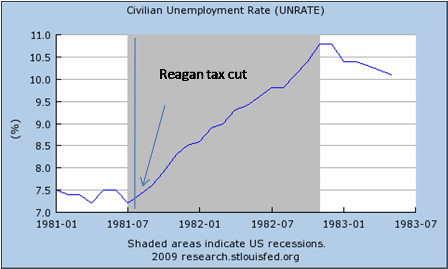
Utter nonsense. Reagan's tax cut was phased in over 3 years. They should have done it all at once but the Democratically controlled Congress wouldn't do it. In addition, the Fed was correctly strangling the economy to drive out the Carter 17% inflation and 21% home mortgage interest rates.
smarter people would bargain. let gays serve, if all women are banned from the military. that's a reasonable compromise.
Long live the Taliban Freedom Fighters!
not one dime of hte stiimulas was spent on anything useful. you do realize that right?
Long live the Taliban Freedom Fighters!
Your facts are way off. First off, there was "Democratically controlled Congress" in 1981 as Republicans took the Senate in the 1980 election. And in the House, a coalition of Blue Dog Democrats and Republicans effectively joined together to give Reagan everything he wanted.
Nope. Reagan wanted an immediate 30% rate cut. He got a 23% rate cut in 3 phases. Those are the facts.
You are buying into the myth that the right wing has created about Reagan, the reality is much different.
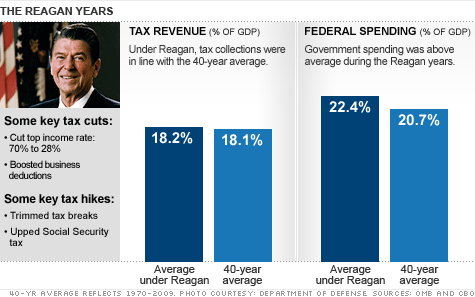
You are confusing tax REVENUES with tax RATES. You chart shows that Reagan cut the top margin tax RATE from 70% to 28%, yet tax revenues were slightly higher under Reagan than the 40 year average. The "supply side" argument is that there are two rates that will produce the same revenue. For example, a tax rate of 104% will produce the same revenue as a tax rate of 0%, namely zero revenue. The supply sider's goal was to find the tax rate that would spur the most economic activity and maximize government revenue. (That is NOT my goal. At the time, I agreed with Milton Friedman who said that if you cut tax rates and tax revenues increase, then tax rates have not been cut enough because we don't want the government to have more money.) Insofar as sociality Security Taxes are concerned, Carter passed those increases, but Reagan accelerated their implementation by a couple of years because early in the 80s, Social Security payments exceeded Social Security taxes. Once the economy recovered, there was a surplus that the politicians pilfered to fund other things. No, Reagan didn't fight enough to cut spending. That's why David Stockman and others (including me) was so irritated with him. Again, I will always support cutting tax rates and closing tax loopholes because the government is incapable of micro-managing the economy. That's why I support the deficit commission, which proposes to cut the top tax rate from 39.6% to 23%, while closing a bunch of loopholes.
"I accept the findings of the report and support repeal based on the Secretary’s recommendations"
On January 3, 2011 the GOP assumes responsibility for deficit spending.
#2. To: go65 (#0)
(Edited)
"It's very important to remember the law is not simply what powerful people would want others to believe it is." -- Julian Assange
#3. To: jwpegler (#2)
Over the last two years, its's been utterly stunning how Obama, Pelosi, and Reid want to address everything except the economy.
I see the following scenario: a weak stimulus plan, perhaps even weaker than what we’re talking about now, is crafted to win those extra GOP votes. The plan limits the rise in unemployment, but things are still pretty bad, with the rate peaking at something like 9 percent and coming down only slowly. And then Mitch McConnell says “See, government spending doesn’t work.”
On January 3, 2011 the GOP assumes responsibility for deficit spending.
#4. To: go65 (#3)
Reagan Tax Cut
"It's very important to remember the law is not simply what powerful people would want others to believe it is." -- Julian Assange
#5. To: go65 (#0)
#6. To: go65 (#3)
#7. To: jwpegler (#4)
Reagan's tax cut was phased in over 3 years. They should have done it all at once but the Democratically controlled Congress wouldn't do it.
On January 3, 2011 the GOP assumes responsibility for deficit spending.
#8. To: go65 (#7)
"It's very important to remember the law is not simply what powerful people would want others to believe it is." -- Julian Assange
#9. To: jwpegler (#8)
(Edited)
On January 3, 2011 the GOP assumes responsibility for deficit spending.
#10. To: go65 (#9)
(Edited)
"It's very important to remember the law is not simply what powerful people would want others to believe it is." -- Julian Assange
Top • Page Up • Full Thread • Page Down • Bottom/Latest
[Home] [Headlines] [Latest Articles] [Latest Comments] [Post] [Mail] [Sign-in] [Setup] [Help] [Register]